
Products and services
We spoke to Miguel Ángel Fernández about the evolution of automatic doors
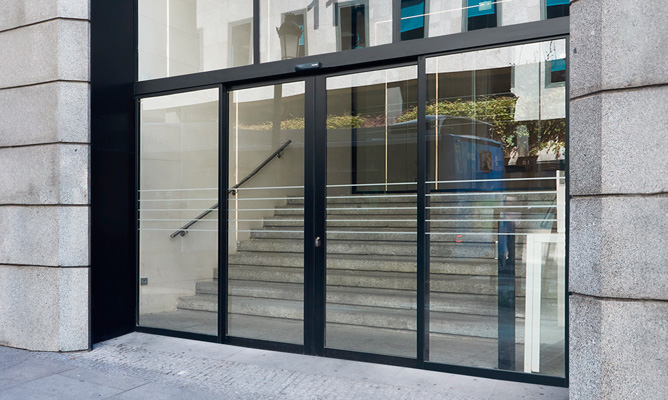
Innovation, design and technology are transforming automatic doors into increasingly smart systems. Miguel Ángel Fernández, Head of R&D&I at Manusa, tells us how they are evolving and the technical challenges shaping their development.
What role does innovation play in the development of automatic doors?
Innovation is an essential part of our work. In a constantly evolving environment, it is necessary to continually challenge existing solutions in order to improve them.
In this regard, connectivity has been one of the most significant developments in recent times. The IoT has transformed the way we interact with automatic doors, enabling their remote management, real-time monitoring and continuous improvement based on usage data.
How have automatic doors evolved in terms of design and functionality?
Nowadays, an automatic door is much more than just a system for opening and closing. It is a smart device that adapts to the flow of people, optimises energy efficiency and improves user experience.
Thanks to connectivity, it is possible to adjust its operation, detect faults and perform remote interventions, increasing efficiency and comfort in buildings.
Could you highlight an example of an innovation project at Manusa?
A good example is the RC2 anti-theft automatic door, designed to offer high resistance to break-in attempts without compromising on aesthetics. It combines security, design and remote control.
Another example is the EI90 hermetic fire-rated door, designed for healthcare environments. It guarantees 90 minutes of fire containment and plays an important role in safety during critical situations, whilst maintaining automation and connectivity.
Taking a broader view, how would you describe Manusa’s R&D&I strategy?
Our R&D&I strategy is rooted in the company’s values: approachability, reliability, flexibility and proactivity. From a technical point of view, reliability is at the centre of all our developments, and we use materials and technologies which ensure optimal long-term performance.
Furthermore, we focus on modular designs that allow us to adapt to each project. Connectivity, through the IoT, enables us to anticipate issues and continuously improve our products.
You mentioned adaptability… How do you tackle the challenge of delivering customised solutions for large-scale projects without compromising on reliability and safety?
In this type of project, we work with modular designs that allow us to adjust dimensions, materials and functionalities without compromising robustness and efficiency. It is also crucial to ensure integration with other building systems and to minimise disruption during installation, particularly in operational infrastructure.
In increasingly connected environments, aspects such as cybersecurity and data management also play a vital role, ensuring that solutions are not only customised but also safe and sustainable in the long term.
At a time when artificial intelligence is transforming every sector, how is it being applied to the development of automatic doors?
Artificial intelligence is revolutionising the way we develop our products. It enables us to optimise processes such as programming, identify new applications and analyse technological trends faster.
It also facilitates task automation and reduces development times, resulting in more efficient, higher-quality solutions.
And finally, how do you see the future of automatic doors in an increasingly digitalised and connected world?
The future lies in access systems that are increasingly intelligent, connected and autonomous. Automatic doors will cease to be passive elements and will become fully integrated into the building’s ecosystem, interacting with systems such as climate control, safety, and people flow management.
The incorporation of technologies such as artificial intelligence will enable us to anticipate incidents before they occur, optimise operation in real time and automatically adapt to the needs of the environment and users.