 Andorra
 Austria
 Belgium
 Bosnia and Herzegovina
 Bulgaria
 Cyprus
 Czech Republic
 Denmark
 Deutschland
 France
 Greece
 Hungary
 Ireland
 Iceland
 Israel
 Italy
Italy
 Latvia
 Luxembourg
 Malta
Malta
 Montenegro
 Netherlands
 Norway
 Poland
 Portugal
 Romania
 Serbia
 Slovakia
 Slovenia
 Spain
Spain
 Sweden
 Switzerland
 Turkey
 Ukraine
 United Kingdom
 Argentina
 Bolivia
 Brasil
 Canada
 Chile
Chile
 Colombia
 Costa Rica
 Cuba
Cuba
 República Dominicana
 Ecuador
 El Salvador
 French Guiana
 Guatemala
 Honduras
 México
 Nicaragua
 Panamá
 Paraguay
 Perú
Perú
 Uruguay
 United States
 Venezuela
 Azerbaijan
 China
China
 Hong Kong
 India
India
 Indonesia
 Iraq
Iraq
 Japan
Japan
 Jordan
 Kuwait
 Lebanon
 Malaysia
 Maurice
 Myanmar
 Oman
Oman
 Pakistan
 Philippines
 Qatar
Qatar
 Russia
 Saudi Arabia
 Singapore
 South Korea
 Syria
Syria
 Thailand
 United Arab Emirates
 Vietnam
 Algeria
 Angola
 Egypt
Egypt
 Ghana
Ghana
 Kenya
Kenya
 Libya
Libya
 Morocco
 Nigeria
 Sénégal
 South Africa
 Tanzania
 Tunisie
 Australia
 New Zealand

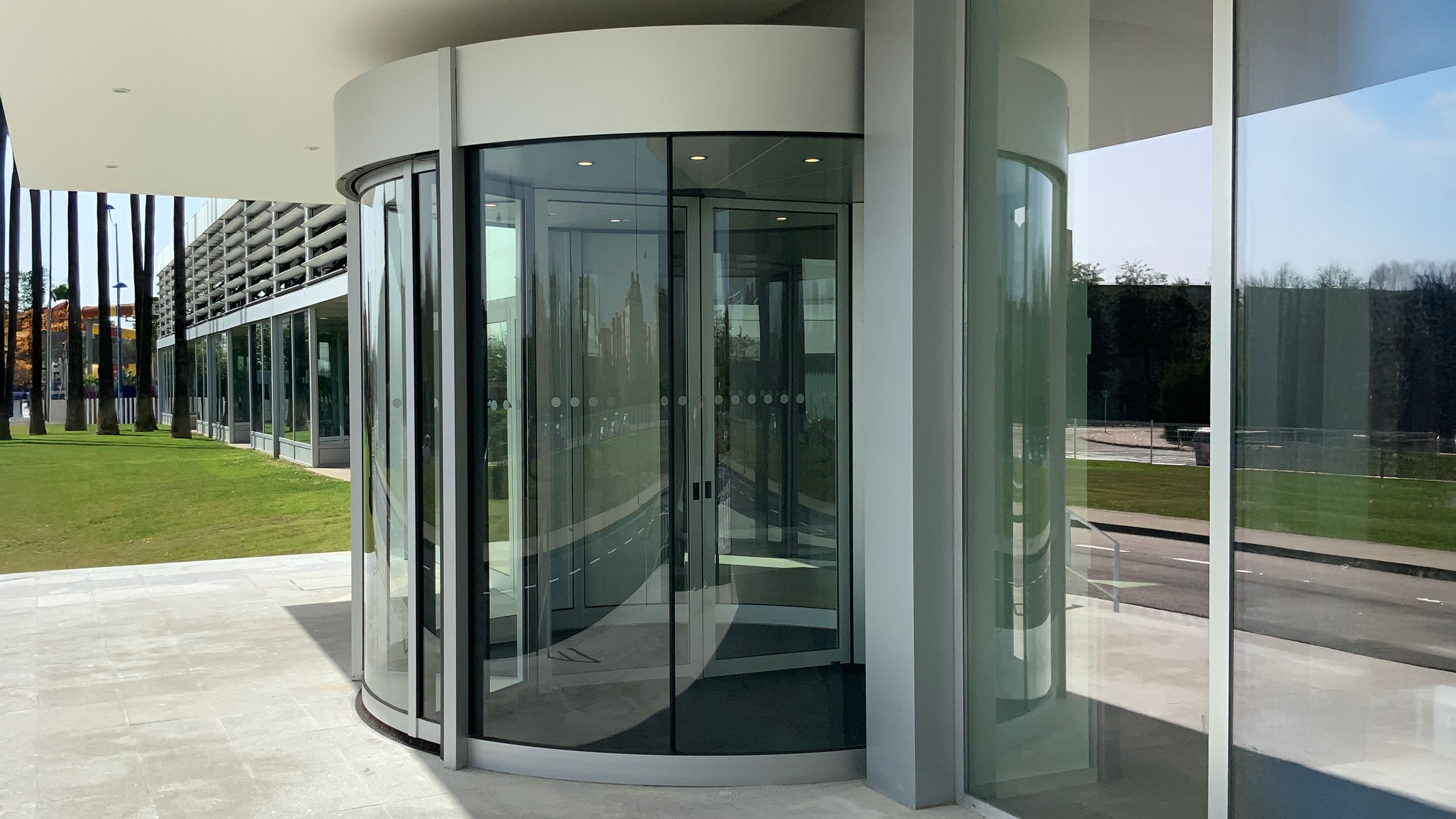
Sound insulation is an increasingly valued technical requirement in buildings where privacy, comfort and control of ambient noise are key factors. In this context, automatic doors not only provide accessibility and energy efficiency, but can also be an effective barrier against sound transmission.
Manusa automatic doors are designed to minimise the passage of noise from outside without compromising functionality or architectural design.
Keys to achieving effective sound insulation
Below, we analyse the main factors to consider to achieve efficient noise control and ensure indoor comfort.
- Suitable materials
The acoustic performance of a door depends largely on the mass, rigidity and absorption of the materials it is made of. To ensure good noise insulation, various materials can be used, including acoustic laminated glass and multi-layer structures. These materials reduce vibrations and filter medium and high sound frequencies.
- Airtight seal
Sound travels through the air, so any gaps or misalignments around the perimeter of the door can compromise its effectiveness. This is why a poorly sealed automatic door will not be able to insulate the building's acoustics properly.
Some automatic doors have sensors and closing control mechanisms that ensure the door is completely closed, leaving no gaps and thus reducing the risk of sound leakage.
- Types of opening
Although automatic doors generally help to control noise, some models are capable of ensuring acoustic insulation in busier spaces. In this sense, revolving doors are a good solution that also provides accessibility for people. Thanks to their circular design, they maintain a constant separation from the outside environment, even with a continuous people flow. This geometric shape prevents direct full opening, which reduces noise entry.
- Installation and technical maintenance
Correct installation is critical, as a poorly installed high-quality door can result in acoustic bridges or leaks. It is therefore essential to take the following factors into account:
- The door must be precisely integrated into the façade or enclosure.
- The weatherstripping, guides and frames must be perfectly aligned.
Another essential factor in ensuring proper functioning is regular technical maintenance.
Sound insulation does not depend solely on the thickness of the material or the type of door, but rather on a comprehensive system that combines materials engineering, structural design, automation, and installation quality. Manusa's solutions offer a technical response to control sound transmission without compromising accessibility or aesthetics.
In environments where acoustic comfort makes all the difference – such as workspaces, shopping centres, restaurants, or hotels – relying on a highly efficient automated solution means opting for the perfect balance between technology, functionality, and well-being.
If this summer you want to improve the comfort of your premises or office, save energy and offer a better experience to your customers, find out how we can help you with the most suitable solution.
Contact us