 Andorra
 Austria
 Belgium
 Bosnia and Herzegovina
 Bulgaria
 Cyprus
 Czech Republic
 Denmark
 Deutschland
 France
 Greece
 Hungary
 Ireland
 Iceland
 Israel
 Italy
Italy
 Latvia
 Luxembourg
 Malta
Malta
 Montenegro
 Netherlands
 Norway
 Poland
 Portugal
 Romania
 Serbia
 Slovakia
 Slovenia
 Spain
Spain
 Sweden
 Switzerland
 Turkey
 Ukraine
 United Kingdom
 Argentina
 Bolivia
 Brasil
 Canada
 Chile
Chile
 Colombia
 Costa Rica
 Cuba
Cuba
 República Dominicana
 Ecuador
 El Salvador
 French Guiana
 Guatemala
 Honduras
 México
 Nicaragua
 Panamá
 Paraguay
 Perú
Perú
 Uruguay
 United States
 Venezuela
 Azerbaijan
 China
China
 Hong Kong
 India
India
 Indonesia
 Iraq
Iraq
 Japan
Japan
 Jordan
 Kuwait
 Lebanon
 Malaysia
 Maurice
 Myanmar
 Oman
Oman
 Pakistan
 Philippines
 Qatar
Qatar
 Russia
 Saudi Arabia
 Singapore
 South Korea
 Syria
Syria
 Thailand
 United Arab Emirates
 Vietnam
 Algeria
 Angola
 Egypt
Egypt
 Ghana
Ghana
 Kenya
Kenya
 Libya
Libya
 Morocco
 Nigeria
 Sénégal
 South Africa
 Tanzania
 Tunisie
 Australia
 New Zealand

This year, Barcelona has been designated the World Capital of Architecture, a distinction that recognises its role as an international benchmark in the fields of architecture and urban planning. In this context, Manusa’s automatic doors are featured in various projects throughout the city, installed in cultural, healthcare, commercial and corporate buildings, where they help to improve the user experience and the functionality of these spaces.
As we seize this special moment for Barcelona’s architectural scene, here at Manusa, we are going to take a monthly tour of the city’s different districts to discover some of the most representative projects we have been involved in, showcasing how our access solutions are designed to meet the needs of each sector.
March – Les Corts
The presence of automatic doors in environments of innovation, knowledge and business activity
We begin our tour in Les Corts, a district characterised by high economic activity within a well-established urban environment: large-scale urban facilities combined with small-scale architecture and neighbourhood amenities. In this context, Manusa has played a vital role by providing key services such as those for the healthcare, hospitality and retail sectors, where automatic doors are part of the day-to-day operation of buildings.
Among them are the Dexeus Clinic and Barcelona Hospital, two leading healthcare centres in the city, renowned for their work in medical innovation and the quality of care they provide. In the business sector, the Trade Buildings, recognised as a site of urban interest, have become an icon of the district thanks to their distinctive cylindrical shape.
Manusa’s involvement in these projects also extends to the hotel sector, with venues such as the Catalonia Mikado and the Hilton Barcelona; the latter is situated next to Avenida Diagonal and is a prime example of international hotel architecture in the city. In the retail sector, El Corte Inglés on Diagonal is one of the area’s main hubs of activity, situated within a vibrant urban environment with a constant flow of people.
April – Sants-Montjuïc
The versatility of automatic doors in urban regeneration/transformation
The itinerary continues in Sants-Montjuïc, Barcelona’s largest district, characterised by its industrial past and urban development. Indeed, Montjuïc has played a leading role in the city’s major transformations, from the 1929 Exhibition to the 1992 Olympic Games. As a result, it is home to some of the city’s most iconic cultural venues, such as the Fundació Miró and the National Museum. In this context, Manusa has participated in projects that reflect the district’s diverse range of uses, where automatic doors facilitate the flow of people in a wide variety of settings.
Among these, the Sants–Eixample Funeral Home and the Sant Pere Claver Health Foundation stand out as two spaces where architecture serves people at particularly sensitive times. In contrast, CaixaForum Barcelona, housed in a former Modernist factory converted into a cultural centre, exemplifies the city’s ability to transform its industrial heritage into new cultural spaces.
Manusa is also present in key infrastructure projects such as Sants Station, one of Barcelona’s main transport hubs, as well as the Hotel Catalonia Plaza and the Centre Parc 5 Estrellas residential complex, where automatic doors help to improve pedestrian flow and access control.
May: Nou Barris
The integration of automatic doors into the social and historical architecture of the district
Our tour now takes us to Nou Barris, a district shaped by labour migration and the unplanned growth of the 1960s. Comprising thirteen neighbourhoods with a strong sense of community, it has undergone significant urban transformation since the 1980s. For example, the emergence of major urban corridors such as Via Júlia and Passeig de Valldaura, and green spaces such as Parc de la Guineueta. As a result of this transformation, we can now observe historical features alongside a completely revitalised urban backdrop.
In this context, Manusa has been involved in projects that reflect the district’s social and community-focused character, with a presence in cultural facilities such as the Les Roquetes – Rafa Juncadella Library and the Nou Barris – Aurora Díaz Plaja Library, the latter of which is housed in one of the buildings of the former Mental Hospital, now converted into a public space.
Manusa’s presence also extends to the healthcare sector, with the Mare de Déu de la Mercè Hospital, and to spaces promoting economic development, such as Nou Barris Activa – Barcelona Activa, where its access solutions help to facilitate the use of facilities and improve people’s day-to-day experiences.
June: Horta-Guinardó
The architecture of infrastructures at the service of the city
The tour continues through the district of Horta-Guinardó, which is characterised by its unique landscape and topography that have historically influenced its urban development. The presence of hills and large natural areas made it necessary to build infrastructures that would ensure the water supply during the growth of Barcelona between the nineteenth and twentieth centuries. As a result of this evolution, spaces such as the Casa de l’Aigua emerged, where heritage, engineering and architecture coexist to explain an essential part of the city's history.
Line 11 of the Barcelona Metro is also part of the outstanding infrastructure that explains the urban evolution of the district. We have installed automatic platform closing doors on this transport network, a solution that contributes to improving passenger safety and managing traffic in a key area for everyday mobility in the city.
The presence of Manusa in the district also extends to one of the most iconic architectural ensembles of the city: the modernist Recinte Modernista de Sant Pau. Declared a World Heritage Site by UNESCO and considered one of the great references of Catalan modernism, this former hospital exemplifies the combination of heritage, innovation and functionality. In this emblematic place, automatic doors contribute to improving accessibility and the movement of people, while respecting the architectural significance of one of Barcelona’s most representative buildings.
July and August: Sant Martí
The evolution of industrial heritage into the architecture of the future
Like few other districts, Sant Martí brings together Barcelona's industrial past and its technological future. Old factories and industrial estates now coexist with innovation centres, creative spaces and contemporary architectural buildings, especially around the 22@ district. An urban transformation that doesn't erase the district's memory but instead integrates it into new uses and ways of living in the city.
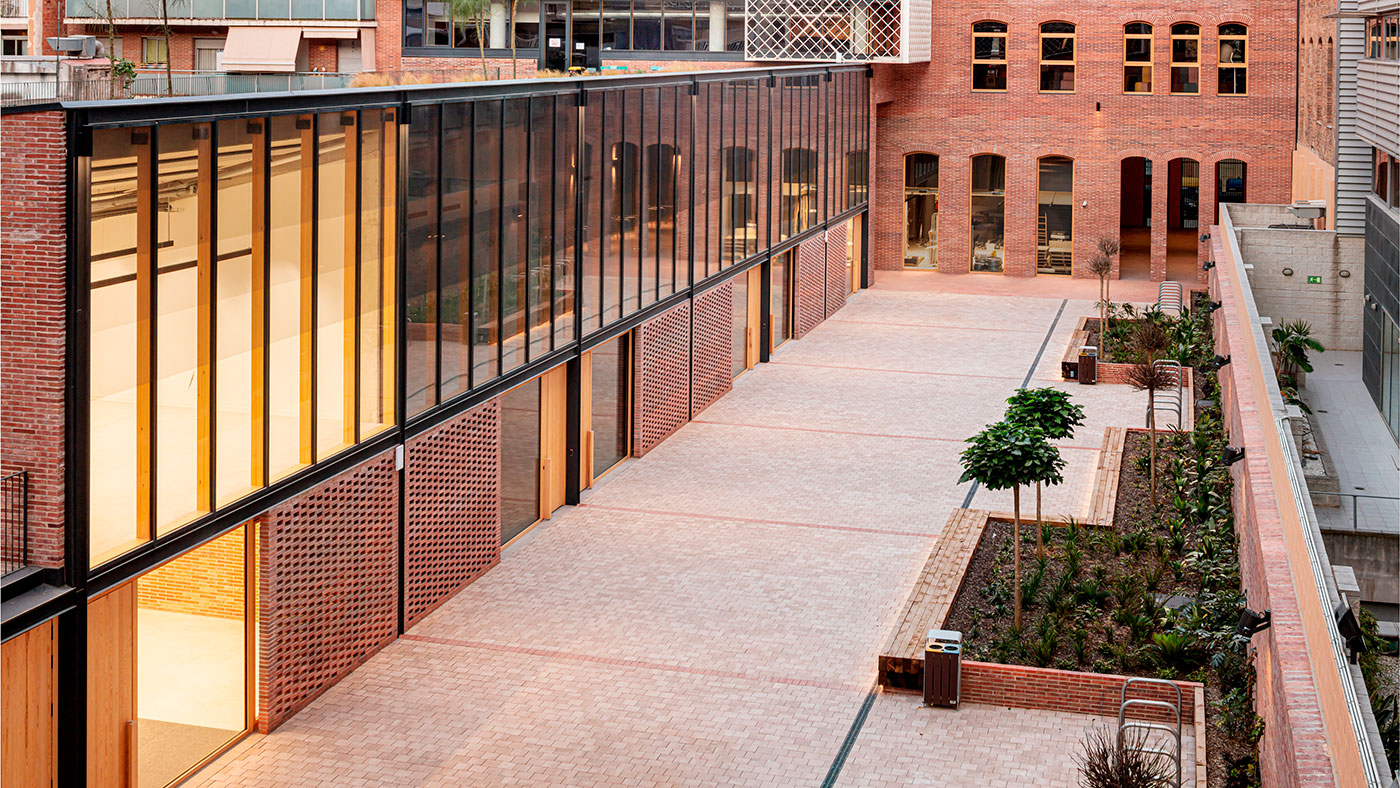
This is the setting for the KNEM offices, a redevelopment project that has restored a former jute factory and transformed it into a sustainable workspace with LEED Gold certification. At the entrances, Manusa has installed automatic sliding doors with central opening, featuring wooden frames and glass leaves that let in natural light. The doors’ opening and closing speed helps reduce air conditioning losses, enhancing the building's energy efficiency.
This transformation is also evident in other iconic locations within the district, such as the Disseny Hub Barcelona, an international benchmark in creativity and innovation, or the Torre Glòries, designed by Jean Nouvel and now one of the major icons of the city's skyline. In both of these spaces, Manusa's automatic doors are integrated into an architecture designed to facilitate the movement of people while effectively accommodating a high volume of use.
Here are some examples of Manusa’s presence in the city of Barcelona. If you’re looking for an access solution tailored to the needs of your space or project, we’ll support you at every stage to find the most suitable option. Please contact us, and we’ll advise you on installing the best solution.
If this summer you want to improve the comfort of your premises or office, save energy and offer a better experience to your customers, find out how we can help you with the most suitable solution.
Contact us