 Andorra
 Austria
 Belgium
 Bosnia and Herzegovina
 Bulgaria
 Cyprus
 Czech Republic
 Denmark
 Deutschland
 France
 Greece
 Hungary
 Ireland
 Iceland
 Israel
 Italy
 Latvia
 Luxembourg
 Malta
 Montenegro
 Netherlands
 Norway
 Poland
 Portugal
 Romania
 Serbia
 Slovakia
 Slovenia
 Spain
 Sweden
 Switzerland
 Turkey
 Ukraine
 United Kingdom
 Argentina
 Bolivia
 Brasil
 Canada
 Chile
 Colombia
 Costa Rica
 Cuba
 República Dominicana
 Ecuador
 El Salvador
 French Guiana
 Guatemala
 Honduras
 México
 Nicaragua
 Panamá
 Paraguay
 Perú
 Uruguay
 United States
 Venezuela
 Azerbaijan
 China
 Hong Kong
 India
 Indonesia
 Iraq
 Japan
 Jordan
 Kuwait
 Lebanon
 Malaysia
 Maurice
 Myanmar
 Oman
 Pakistan
 Philippines
 Qatar
 Russia
 Saudi Arabia
 Singapore
 South Korea
 Syria
 Thailand
 United Arab Emirates
 Vietnam
 Algeria
 Angola
 Egypt
 Ghana
 Kenya
 Libya
 Morocco
 Nigeria
 Sénégal
 South Africa
 Tanzania
 Tunisie
 Australia
 New Zealand

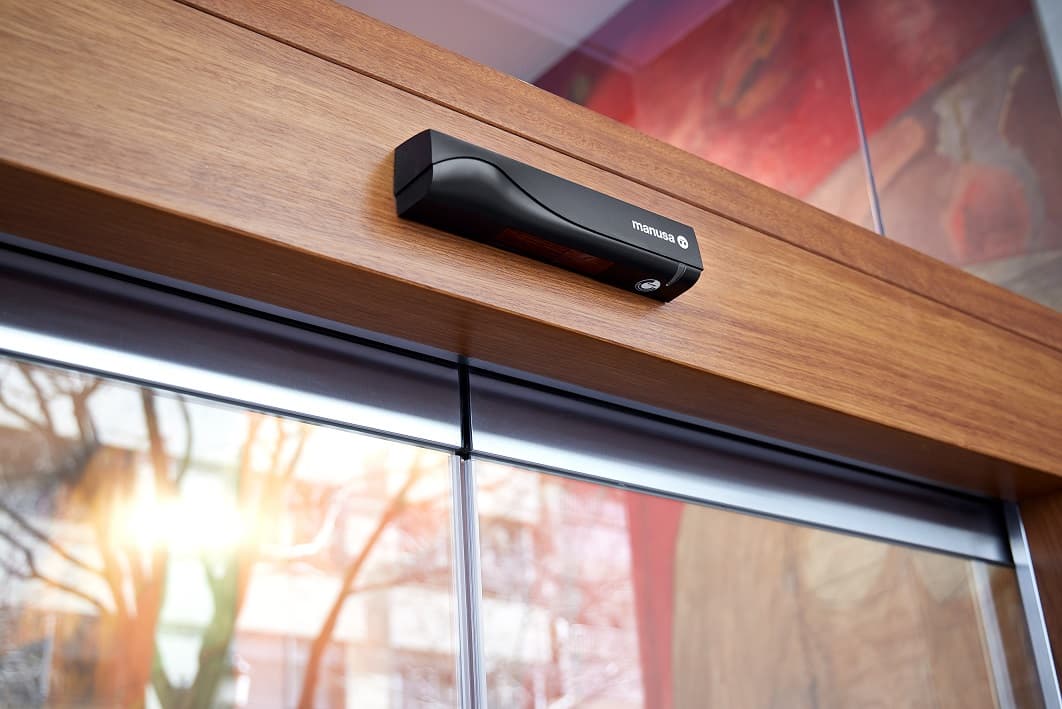
Sensors for automatic doors allow the opening to be adapted to the way people use each entrance. The motion sensors detect the user's approach, while the proximity sensors allow the door to be activated without touching any device. There are sensors that combine motion detection and presence to monitor the passage area and detect possible obstacles.
At Manusa, we develop different detection and activation solutions that can be combined and configured according to the specific needs of each installation. Accessibility, safety, hygiene, type of traffic or form of activation are some of the key factors that help determine the most suitable system for each project.
How do the automatic door sensors operate?
The automatic door sensors detect the user's approach, presence or gesture using technologies such as microwave radar or active infrared. When they identify one of these signs, they send a command to the door operator to open or stay open while the passage area is occupied.
From this, it can be deduced that not all the sensors of an automatic door work with the same technology or analyse the same information. Some use microwaves to detect movement, others use active infrared to monitor the presence in the passage area, and some combine both technologies in the same device.
These differences condition their behaviour. A directional radar, for example, can recognise the direction in which a person is moving, helping to adjust the opening time. Hybrid sensors can combine a radar field to detect approach with an infrared curtain to monitor the threshold and keep the door open if there is an obstacle, even when it remains stationary.
There are also proximity sensors with adjustable detection distances, designed to activate the door by a gesture close to the device. The chosen technology and its configuration make it possible to adapt the operation of the door to the type of traffic, available space and level of control required in each installation.
Types of sensors for automatic doors
There are different types of sensors, each designed to respond to specific operational and safety needs.
1. Motion sensors
Motion sensors for automatic doors use microwave radar to detect approaching people or objects. When they detect movement within their detection field, they send a signal that activates the door.
They are especially suitable for entrances to commercial buildings, offices or facilities with high footfall.
2. Presence and safety sensors
Unlike motion sensors, presence sensors make it possible to detect people or obstacles that remain motionless within a certain area.
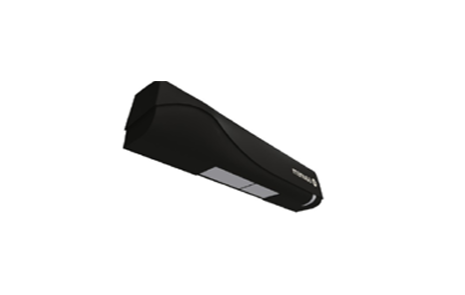
Hybrid sensors, such as Manusa's DDS models, combine microwave and active infrared technologies to detect movement and monitor the presence of people on the threshold.
In this way, they help to prevent the doors from closing while someone is in the passageway, thereby enhancing user safety.
3. Proximity sensors
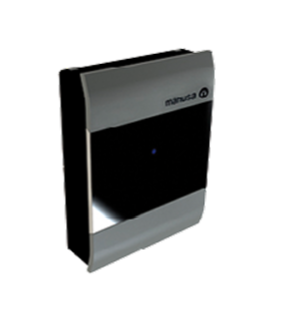
Proximity sensors allow you to activate an automatic door without touching any device. Simply move your hand closer to the sensor to trigger the opening command.
At Manusa, solutions such as Smart-Prox and Optima Prox+ include adjustable detection distances and luminous indicators that confirm activation.
They are especially useful in hospitals, clinics, laboratories and other spaces where it is important to reduce contact with shared-use surfaces.
Motion sensor for automatic doors: how it operates
The motion sensor is the most widely used activation system for automatic doors. Its function is to detect the presence of people or objects approaching the entrance and to trigger the door to open before they reach the door, ensuring a smooth passage without any waiting.
How does it detect movement? Most of these sensors use microwave radar. The device emits a signal that reflects off everything within its detection field. When something moves in that area, the reflected signal changes. The sensor interprets this change as movement and sends an opening command to the operator.
The detection field can be configured in size, orientation and sensitivity. This way, it adapts to the width of the passageway, the space available in front of the door and the type of traffic, and prevents unnecessary openings.
Some models, such as the Manusa Planar 2.0, also recognise the direction of movement. This enables them to distinguish those who are heading for the door from those who are simply walking past, thereby reducing opening time and minimising heat loss.
Because it reacts to movement, this sensor does not detect a person stopping at the threshold. Therefore, it is often combined with a presence and security sensor, or it may be replaced by a hybrid model. This type of sensor is particularly well-suited for entrances with frequent and continuous traffic, such as in shops, shopping centres, offices, hotels, or public buildings. In these spaces, the door must open automatically and in advance, allowing users to pass through without having to take any action.
Comparison of sensors for automatic doors
How to choose the right sensor for an automatic door?
The choice depends on the characteristics of the installation and the expected performance of the door. Before selecting a sensor, it is advisable to evaluate several aspects:
- Traffic intensity: in entrances with continuous circulation, motion sensors automate opening and speed up the passage.
User safety: presence sensors help to detect obstacles and keep the door open while the passageway is occupied.
Hygiene needs: proximity sensors allow voluntary activation without physical contact.
Door type and compatibility: it is important to verify that the device is compatible with the operator and the features of the installation.
In certain projects, combining different detection technologies makes it possible to better adapt the operation of the door to the needs of the space.
Choosing the right sensor makes it possible to adapt the operation of an automatic door to the traffic of people, safety conditions and hygiene needs of each space.
At Manusa, we have different detection and activation technologies for automatic doors. If you are developing a project or need to improve the operation of an existing installation, our team can help you identify the most appropriate solution. Get in touch with us!
If this summer you want to improve the comfort of your premises or office, save energy and offer a better experience to your customers, find out how we can help you with the most suitable solution.
Contact usFrequently asked questions about automatic door sensors
Yes. The proximity sensors make it possible to activate the opening by holding your hand closer to the detector, without pressing any buttons. This technology is especially useful in facilities where physical contact should be minimised.
Motion sensors are suitable for entrances with frequent circulation, as they allow the opening to be activated automatically. Their combination with presence detection and safety systems helps to protect users during passage.
Motion sensors are usually installed at the top of the automatic door, oriented towards the approach area of people. Its location and orientation must be adjusted to the characteristics of the entrance to ensure proper detection and prevent unnecessary activations.
Yes. Many sensors for automatic doors allow you to adjust parameters such as sensitivity, range or detection field. These configurations help to adapt their operation to the traffic of people and the characteristics of the surroundings. Adjustments should be carried out by qualified professionals to ensure correct detection.
An automatic door may open for no apparent reason or fail to detect people due to incorrect sensor settings, dirt buildup, interference or malfunctions within the detection system. If this issue persists, it is recommended to request a technical review to identify its cause.
To find out the possible causes and solutions, please refer to our guides on automatic doors that open by themselves and automatic doors that do not open.
Automatic pedestrian doors must have safety sensors that comply with the UNE-EN 16005 standard, which outlines safety requirements for this type of door during its use. The installation must include the appropriate protective devices and be configured to detect the presence of people or obstacles in areas where risks may arise.