Andorra
 Austria
 Belgium
 Bosnia and Herzegovina
 Bulgaria
 Cyprus
 Czech Republic
 Denmark
 Deutschland
 France
 Greece
 Hungary
 Ireland
 Iceland
 Israel
 Italy
Italy
 Latvia
 Luxembourg
 Malta
Malta
 Montenegro
 Netherlands
 Norway
 Poland
 Portugal
 Romania
 Serbia
 Slovakia
 Slovenia
 Spain
Spain
 Sweden
 Switzerland
 Turkey
 Ukraine
 United Kingdom
 Argentina
 Bolivia
 Brasil
 Canada
 Chile
Chile
 Colombia
 Costa Rica
 Cuba
Cuba
 República Dominicana
 Ecuador
 El Salvador
 French Guiana
 Guatemala
 Honduras
 México
 Nicaragua
 Panamá
 Paraguay
 Perú
Perú
 Uruguay
 United States
 Venezuela
 Azerbaijan
 China
China
 Hong Kong
 India
India
 Indonesia
 Iraq
Iraq
 Japan
Japan
 Jordan
 Kuwait
 Lebanon
 Malaysia
 Maurice
 Myanmar
 Oman
Oman
 Pakistan
 Philippines
 Qatar
Qatar
 Russia
 Saudi Arabia
 Singapore
 South Korea
 Syria
Syria
 Thailand
 United Arab Emirates
 Vietnam
 Algeria
 Angola
 Egypt
Egypt
 Ghana
Ghana
 Kenya
Kenya
 Libya
Libya
 Morocco
 Nigeria
 Sénégal
 South Africa
 Tanzania
 Tunisie
 Australia
 New Zealand

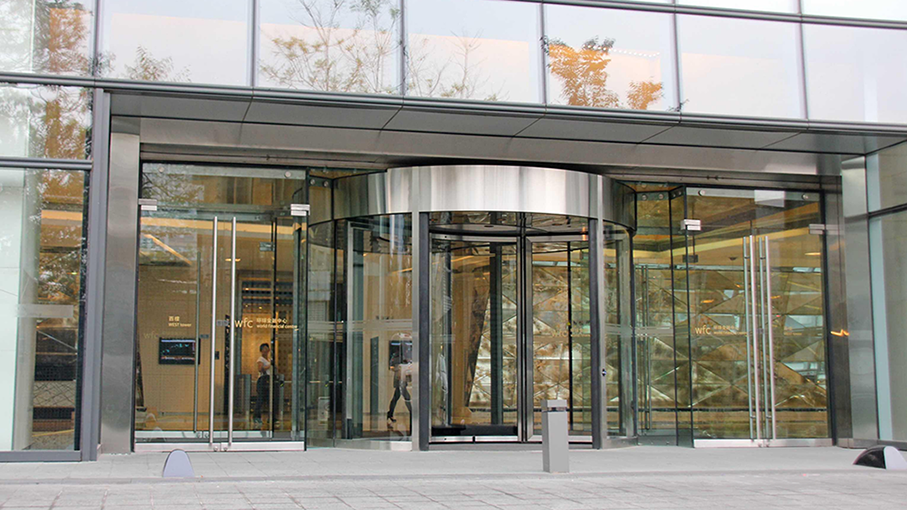
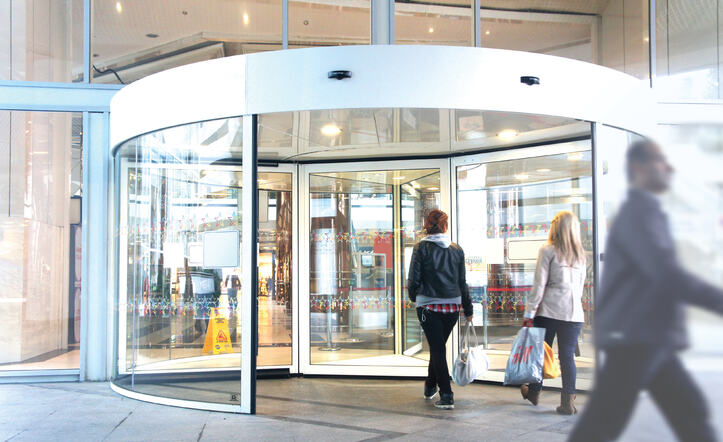
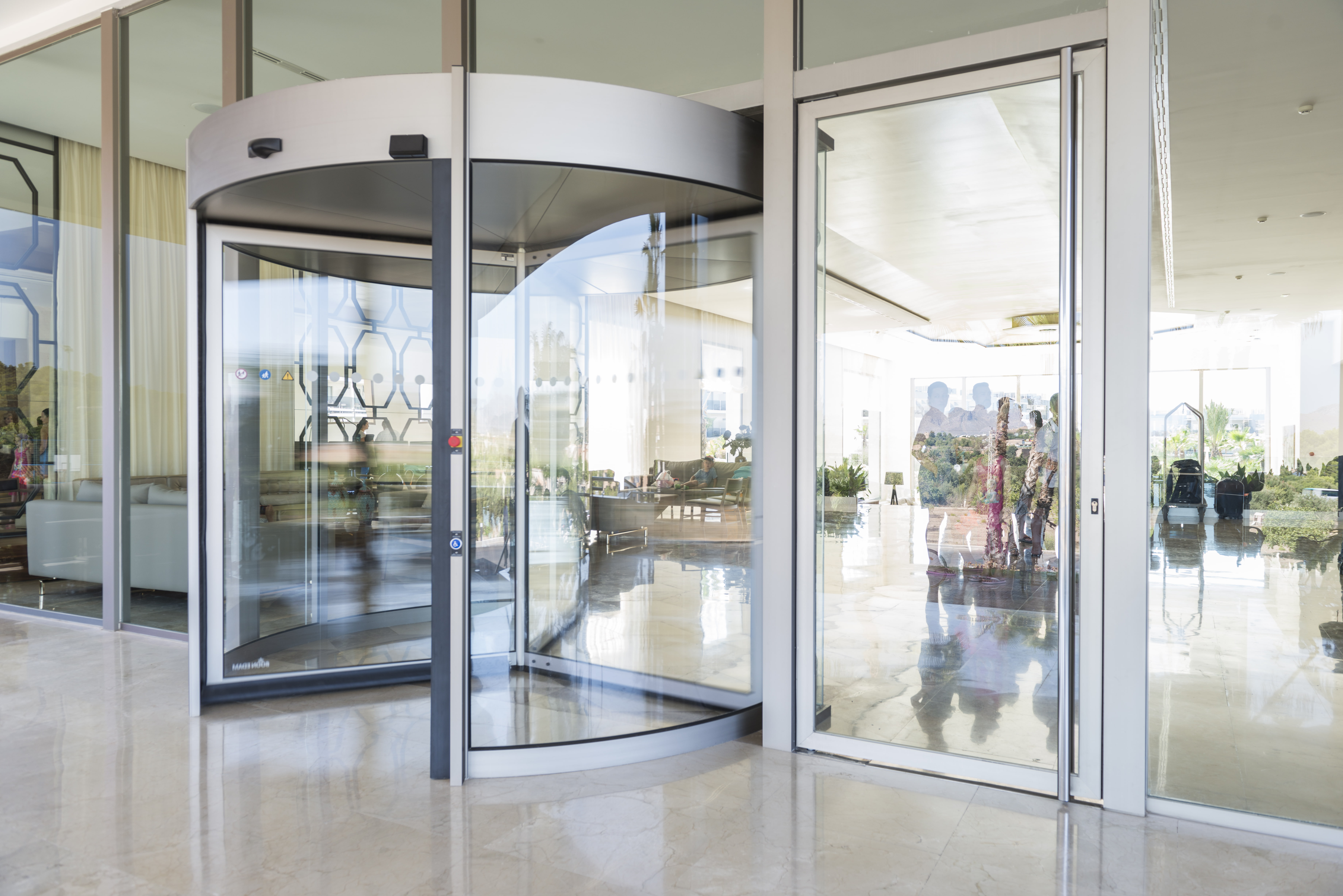
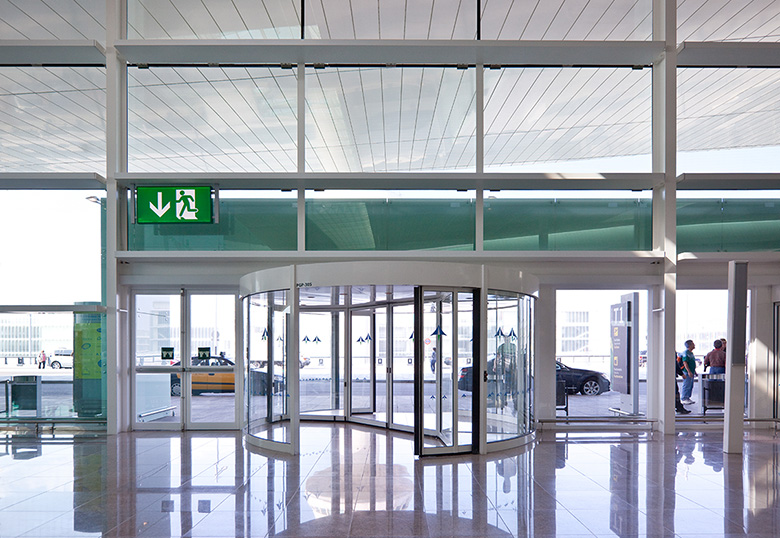
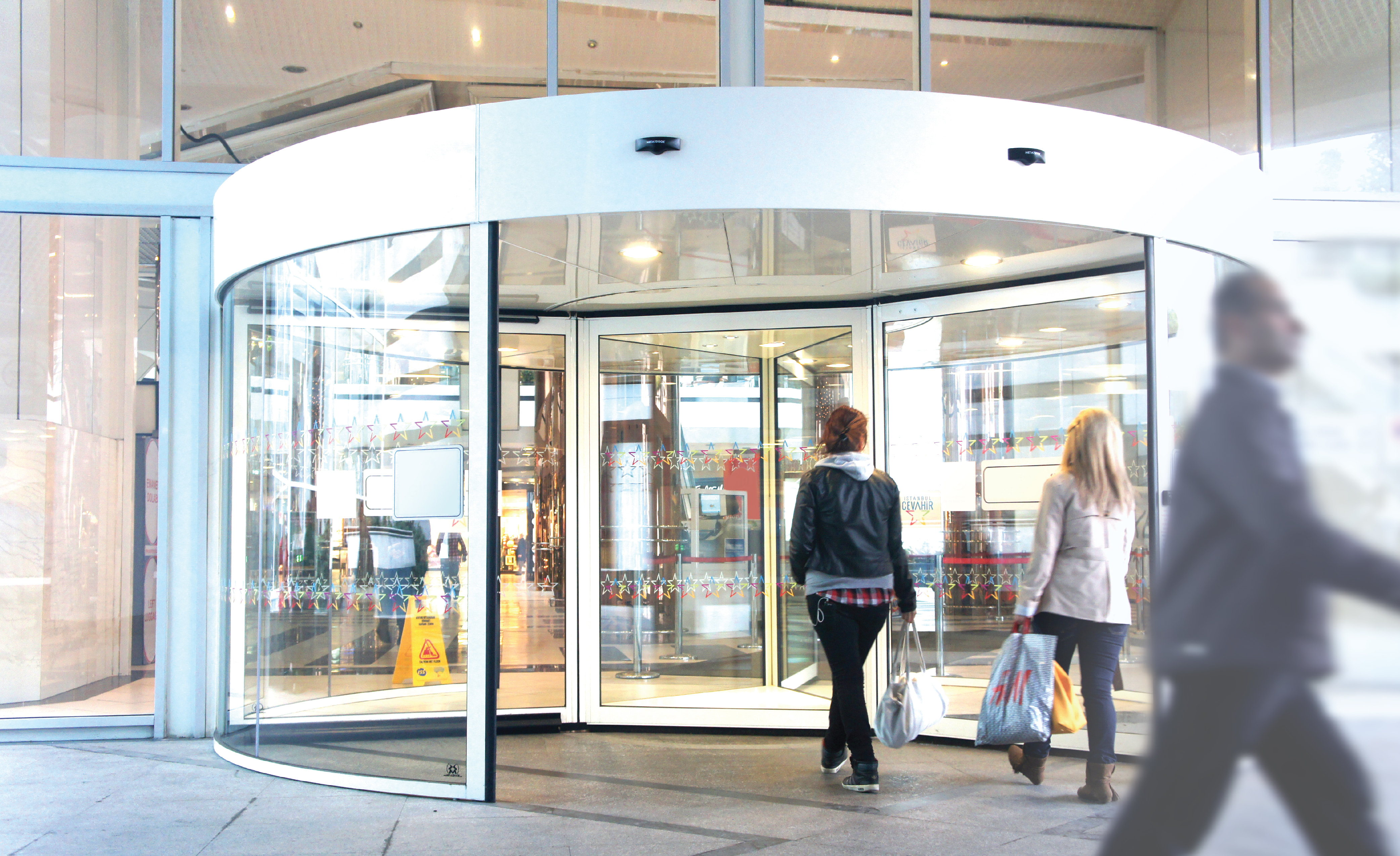
Automatic revolving doors allow the flow of people to be managed while maintaining a continuous separation between the interior and exterior of the building. This feature makes them a particularly interesting solution for entrances with high foot traffic, where thermal comfort, energy efficiency and architectural integration are also key considerations.
Hotels, airports, corporate buildings, shopping centres, museums and institutional buildings are just some of the venues where this type of door can be found.
However, not all revolving doors meet the same requirements. Pedestrian flow, frequency of use, available diameter, type of users, the architecture of the entrance and environmental conditions must all be analysed before determining the appropriate configuration.
A revolving door allows traffic to be managed without directly connecting the interior and exterior while people are passing through.
This particular mode of operation accounts for many of its advantages in main entrances with high usage frequency and in air-conditioned spaces.
What is an automatic revolving door?
An automatic revolving door consists of several leaves that rotate around a central axis, creating different compartments as they move.
Unlike other systems, the entrance is not left completely open between the outside and the inside while people are passing through. The different segments maintain a physical separation between the two areas while people pass through the door.
The automatic movement prevents users from having to push the leaves, ensuring a continuous and orderly flow of traffic.
Depending on the model, there are configurations available with different numbers of leaves, diameters, finishes and features to suit the volume of traffic and the type of building.
Segment-based operation
The leaves rotate around a central axis and guide the user from one side of the entrance to the other.
Throughout the passage, the different segments help maintain a more consistent separation between the indoor and outdoor environments, even when there is a constant flow of people.
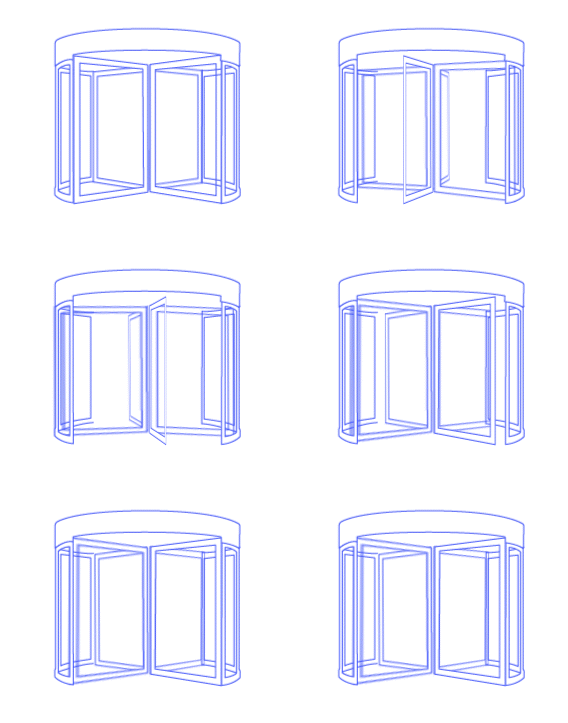
How does an automatic revolving door work?
Sensors detect when a person is approaching, and the system activates the movement of the door leaves. These rotate at a controlled speed around the central axis while the user passes through one of the segments until they reach the inside or outside of the building.
Throughout the entire passage, the compartments prevent direct contact between the two environments.
Detection and safety systems also monitor the passageway and allow the door’s operation to be adapted in response to the presence of people or obstacles.
The result is a continuous flow of traffic that combines automation, traffic control and environmental separation.
Safety in automatic pedestrian doors
Automatic revolving doors must be configured with due regard for the safety of people throughout the entire movement cycle.
The EN 16005 standard sets out safety requirements for the use of automatic pedestrian doors. Building on this basis, the specific configuration must take into account aspects such as detection devices, movement control and the characteristics of the environment in which the door is installed.
What are the advantages of automatic revolving doors?
Automatic revolving doors combine continuous flow of traffic with a constant separation between the interior and exterior. This configuration can favour thermal insulation, reduce draughts and losses of climate-controlled air, protect the entrance hall from certain external conditions, and lend the entrance a striking architectural presence.
They help maintain the indoor thermal conditions
A revolving door prevents the exterior and interior from being directly connected while people are passing through.
This helps to reduce draughts and temperature fluctuations that can occur in entrances with a high volume of foot traffic.
It improves thermal insulation, and it can help maintain more stable indoor conditions in air-conditioned buildings.
They contribute to the building’s energy efficiency
Limiting direct air exchange also helps to reduce heating and cooling losses.
In a busy entrance, this feature can help ensure that heating or cooling systems need to compensate less for thermal variations caused by the continuous flow of people.
The ultimate benefit will always depend on factors such as the volume of foot traffic, outdoor conditions, the dimensions of the entrance and the chosen configuration.
They allow for continuous traffic flow
Revolving doors organise the flow into different sections that can be used simultaneously.
This allows for a continuous flow of people entering and exiting without having to complete a full opening and closing cycle for each user.
Capacity will depend on the diameter, the number of leaves and the model’s features. Therefore, the frequency of use and the anticipated pedestrian flow must be taken into account when determining the appropriate size.
They protect against outdoor conditions
The design of the door creates a barrier between the building and the outside.
As well as minimising draughts, it can help to reduce the ingress of wind, rain, noise and outdoor dirt.
This protective feature is one of the reasons why revolving doors are commonly used at the main entrances to buildings with heavy foot traffic, particularly where there is also a need to maintain more stable indoor conditions.
They add architectural presence
A revolving door often becomes a striking feature of the entrance.
The various options for glass, structure, finishes and design allow it to be incorporated into projects where the architectural image is of great importance.
This is why they are commonly found in hotels, corporate headquarters, institutional buildings and cultural venues, where the entrance forms part of the building’s identity.
They incorporate safety and control systems
Automatic revolving doors incorporate devices designed to monitor foot traffic and adapt their movement to users.
Depending on the configuration, they can incorporate presence sensors, speed control and safety systems, and connect to access control systems when the project specifications require it.
Certain models may also incorporate specific configurations to respond to emergency situations.
Maintaining comfort even with constant foot traffic
A revolving door limits direct contact between the outside and inside while people are passing through.
This feature helps to reduce draughts and maintain more stable thermal control conditions in the lobby.
¿What types of automatic revolving doors are available?
There is no single configuration that suits all projects. Manusa offers a range of solutions to adapt the door to the foot traffic, available space and architectural features of each entrance.
Standard automatic revolving door
The standard automatic revolving door is suitable for main entrances with a moderate or frequent flow of people.
It combines the main advantages of a revolving door — environmental separation, comfort and continuous flow — with a range of customisation options.
It can be installed in hotels, offices, public buildings, shopping centres and other spaces where the aim is to balance functionality with architectural appeal.
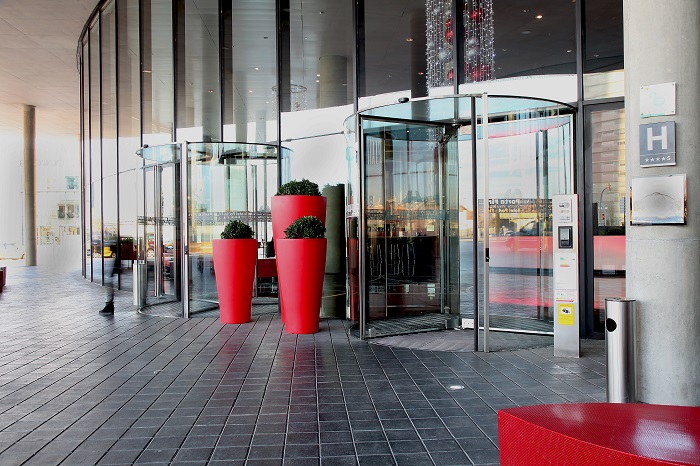
Transparent automatic revolving door
The transparent automatic revolving door emphasises the glass and visually minimises the presence of other structural elements.
This configuration enhances the brightness and visual continuity of the entrance, making it particularly suitable for projects where transparency plays an important role.
Hotels, corporate buildings and institutional spaces are some of its common applications.
Transparency also at the entrance
In projects where light and visual continuity are part of the architecture, a transparent revolving door helps to reduce the visual bulk of the structure and allow the glass to take centre stage.
Functionality and design are thus integrated into a single entrance element.
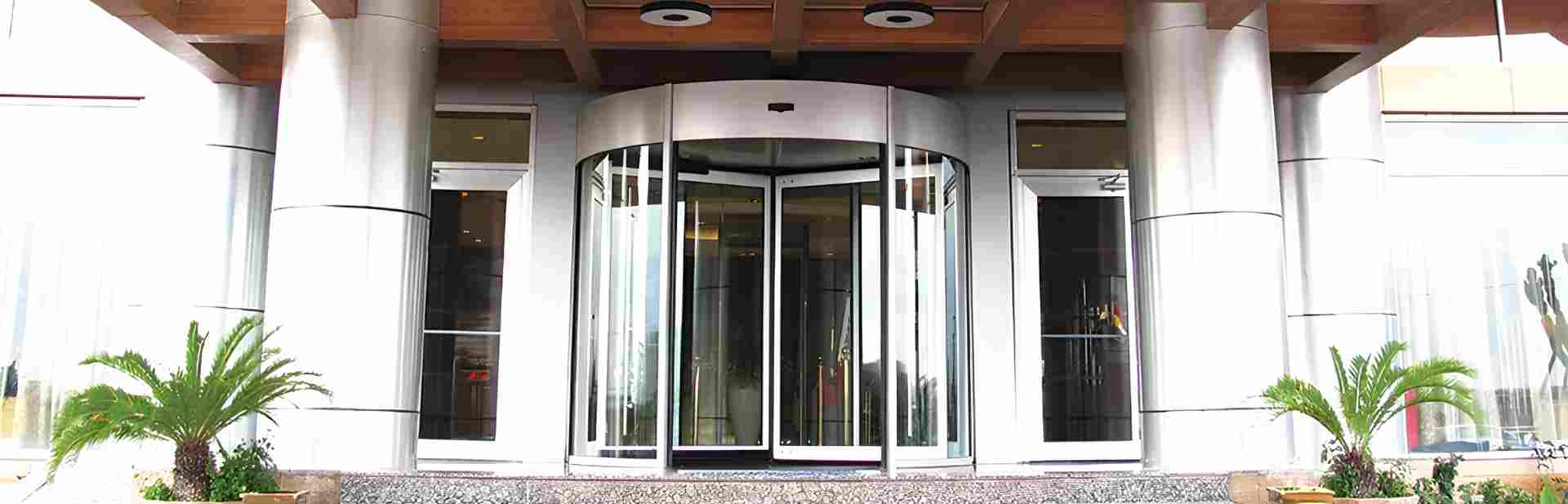
Multifunctional automatic revolving door
Depending on the project’s requirements, the multifunctional automatic revolving door can be fitted with a sliding door or a manual or automatic swing door, with the option of an anti-panic system.
This configuration allows the entrance’s operation to be adapted to different situations and provides a wider direct passageway when circumstances require it.
It is particularly suitable for entrances with high foot traffic and varying requirements throughout the day.
Large automatic revolving door
Large revolving doors feature wider segments and a greater passage capacity.
They can facilitate the circulation of people with luggage, trolleys, wheelchairs or other bulky items.
They are an option worth considering in airports, large shopping centres, hotels, hospitals or buildings with high pedestrian flow, always depending on the specific conditions of the project.
Diameter determines capacity
The diameter of a revolving door directly influences the space available within each segment and the entrance’s passage capacity.
Therefore, sizing a revolving door is not simply a matter of checking whether it fits through the opening. It is also necessary to analyse the number and type of users, peak times and the routes taken before and after passing through the door.
Where is it best to install automatic revolving doors?
Revolving doors are particularly suitable for main entrances where there is a high volume of foot traffic, air-conditioning and architectural significance.
Hotels
A hotel entrance is a hub for guests with luggage, visitors, staff and service trolleys.
A revolving door allows for a continuous flow of people while minimising direct contact between the outside and the climate-controlled lobby.
Furthermore, its architectural presence can be integrated into the entrance design and form part of the establishment’s image.
Airports and stations
Airports and major transport facilities see a constant flow of travellers, many of whom are carrying luggage or trolleys.
In such spaces, it may be necessary to opt for high-capacity layouts that accommodate high traffic flow while providing sufficiently wide passageways.
The solution must be designed taking into account peak times, the type of user and subsequent routes.
Corporate and institutional buildings
In corporate and institutional buildings, the main entrance combines functionality with a sense of prestige.
Revolving doors can help maintain thermal control in the lobby, manage the flow of staff and visitors, and provide an architectural feature that is consistent with the building’s design.
Shopping centres
Large shopping centres can see a continuous flow of people over extended periods.
At their external entrances, a revolving door can help reduce draughts and temperature fluctuations without hindering the flow of people.
The diameter and capacity must be tailored to the expected volume of visitors.
Museums and cultural buildings
In museums and cultural venues, the door must manage visitor flow while blending into buildings where architecture is of particular importance.
A transparent design or one with particular attention to detail can maintain the visual continuity of the façade while ensuring the comfort of the interior lobby.
Hospitals
In hospitals, a revolving door can be used at certain main entrances where there is a high volume of traffic and where greater separation between outdoor and indoor conditions is required.
In other areas of the facility, requirements may call for sliding doors, hermetic doors or other specific solutions. The guide to automatic doors for hospitals provides further details on the requirements for each area.
What should you consider before choosing a revolving door?
The choice does not depend solely on the appearance of the entrance. To select the right solution, several factors must be taken into account.
Foot traffic and frequency of use
You need to know how many people will use the door and how that foot traffic is distributed throughout the day.
It is not enough to calculate an average. You must also analyse peak periods and the frequency of use.
The diameter and configuration must be suited to that actual foot traffic.
The type of users
How they enter is also important.
A building where pedestrians are the main users presents different requirements from an airport with luggage, a hotel with suitcases or a shopping centre with trolleys.
Where bulky items are frequently moved through the entrance, it may be necessary to consider larger-diameter models or multi-purpose configurations.
Accessibility and required clearance
The design must take into account the characteristics of all users and the space required to pass through the entrance safely.
People with reduced mobility, wheelchair users, luggage, pushchairs or trolleys may influence the diameter, configuration and available passage space.
Consideration must also be given to the accessibility regulations applicable to the building and, when relevant, the layout of the accessible route.
Available space
A revolving door requires sufficient space to accommodate its diameter.
It is therefore important to assess the available depth, the width of the entrance, and the approach and exit routes.
A revolving door that is too large may unnecessarily restrict the entrance hall; one that is too small may limit the intended flow of people.
Outdoor conditions
Exposure to wind, rain, cold or heat also influences the decision.
Particularly in entrances where there is a significant difference between outdoor and indoor conditions, the door’s ability to limit direct air exchange becomes more important.
Architectural integration
Glass, structure, finishes and dimensions all contribute to the visual appearance of the entrance.
The door must meet both the functional requirements and the architectural language of the project.
The choice between a standard, transparent, multi-functional or large-scale solution must always take into account the relation between functionality and design.
Which revolving door to choose depending on your needs?
The table serves as a general guide. The actual flow, foot traffic, available space, users and environmental conditions must all be analysed together before the model is selected.
What if the entrance needs two different operating modes?
Certain projects require a combination of the advantages of a revolving door with the option of a wider direct passageway.
The multifunction automatic revolving door combines both options in a single unit and allows its operation to be adapted to the entrance’s various requirements.
Automatic or manual revolving door: what’s the difference?
The main difference lies in how the movement is generated.
With a manual door, the user moves the door leaves. With an automatic door, the operator controls the rotation and allows for continuous movement without the need to push the door.
Automation also facilitates the incorporation of sensors, movement regulation and various control and safety systems.
Therefore, in buildings with a high frequency of use, automation can offer more consistent operation and better management of pedestrian flow.
When to choose an automatic revolving door?
A revolving door may be particularly suitable when several of the following factors apply:
Frequent or continuous foot traffic at the main entrance.
The need to minimise draughts and loss of thermal control.
Sufficient space to accommodate the required diameter.
The importance of the entrance’s architectural presence.
The need to adapt capacity to the type of users and the anticipated flow.
If the main priority is to have a completely direct passageway or if the available space is limited, it may be more appropriate to consider another type of door.
A comparison between sliding and revolving doors allows for a more detailed analysis of the differences between the two systems.
Find the right revolving door for your project
Foot traffic, diameter, users, outdoor conditions and architecture determine which configuration is best suited to each entrance.
An entrance that combines traffic flow, comfort and architecture
Automatic revolving doors enable the management of pedestrian traffic while maintaining a more consistent separation between the interior and exterior.
This feature can help reduce draughts, better maintain thermal conditions and protect the entrance hall from certain external conditions, while the door itself integrates as a key architectural element.
However, their performance depends on making the right choice.
Pedestrian flow, frequency of use, type of user, diameter, available space, accessibility, exposure to the elements and the building’s design must all be analysed together to determine which revolving configuration best suits the actual operation of each entrance.
 Manusa automatic revolving doors catalogue
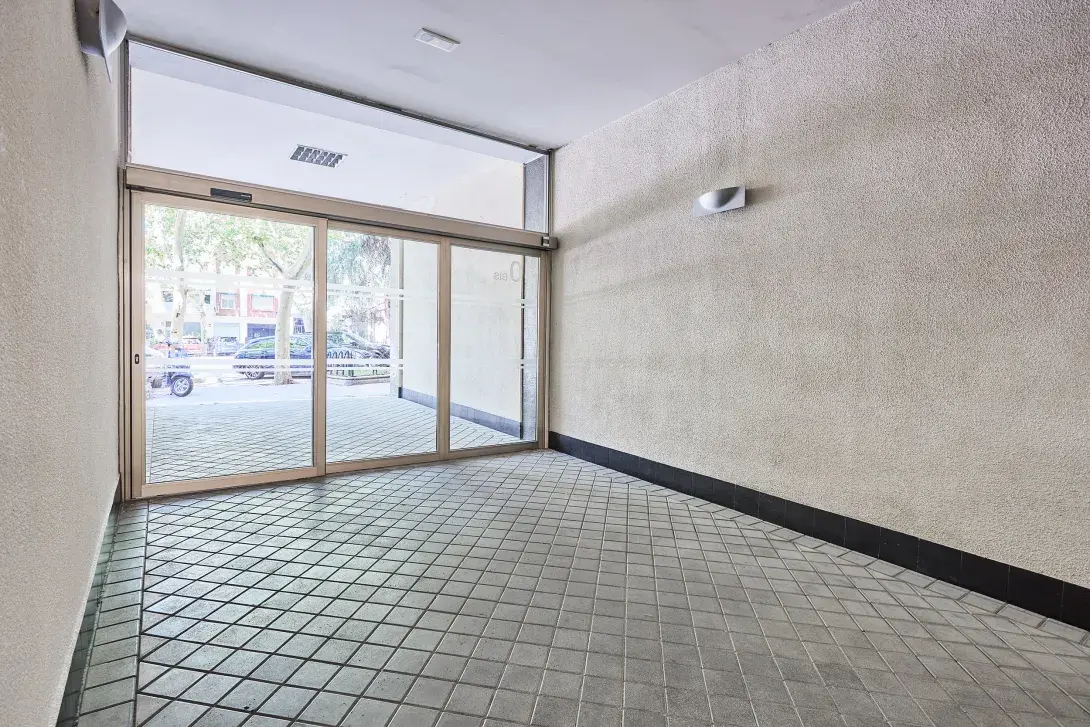
If this summer you want to improve the comfort of your premises or office, save energy and offer a better experience to your customers, find out how we can help you with the most suitable solution.
Contact us
Related solutions
Standard automatic revolving door
Automatic transparent revolving door