 Andorra
 Austria
 Belgium
 Bosnia and Herzegovina
 Bulgaria
 Cyprus
 Czech Republic
 Denmark
 Deutschland
 France
 Greece
 Hungary
 Ireland
 Iceland
 Israel
 Italy
Italy
 Latvia
 Luxembourg
 Malta
Malta
 Montenegro
 Netherlands
 Norway
 Poland
 Portugal
 Romania
 Serbia
 Slovakia
 Slovenia
 Spain
Spain
 Sweden
 Switzerland
 Turkey
 Ukraine
 United Kingdom
 Argentina
 Bolivia
 Brasil
 Canada
 Chile
Chile
 Colombia
 Costa Rica
 Cuba
Cuba
 República Dominicana
 Ecuador
 El Salvador
 French Guiana
 Guatemala
 Honduras
 México
 Nicaragua
 Panamá
 Paraguay
 Perú
Perú
 Uruguay
 United States
 Venezuela
 Azerbaijan
 China
China
 Hong Kong
 India
India
 Indonesia
 Iraq
Iraq
 Japan
Japan
 Jordan
 Kuwait
 Lebanon
 Malaysia
 Maurice
 Myanmar
 Oman
Oman
 Pakistan
 Philippines
 Qatar
Qatar
 Russia
 Saudi Arabia
 Singapore
 South Korea
 Syria
Syria
 Thailand
 United Arab Emirates
 Vietnam
 Algeria
 Angola
 Egypt
Egypt
 Ghana
Ghana
 Kenya
Kenya
 Libya
Libya
 Morocco
 Nigeria
 Sénégal
 South Africa
 Tanzania
 Tunisie
 Australia
 New Zealand

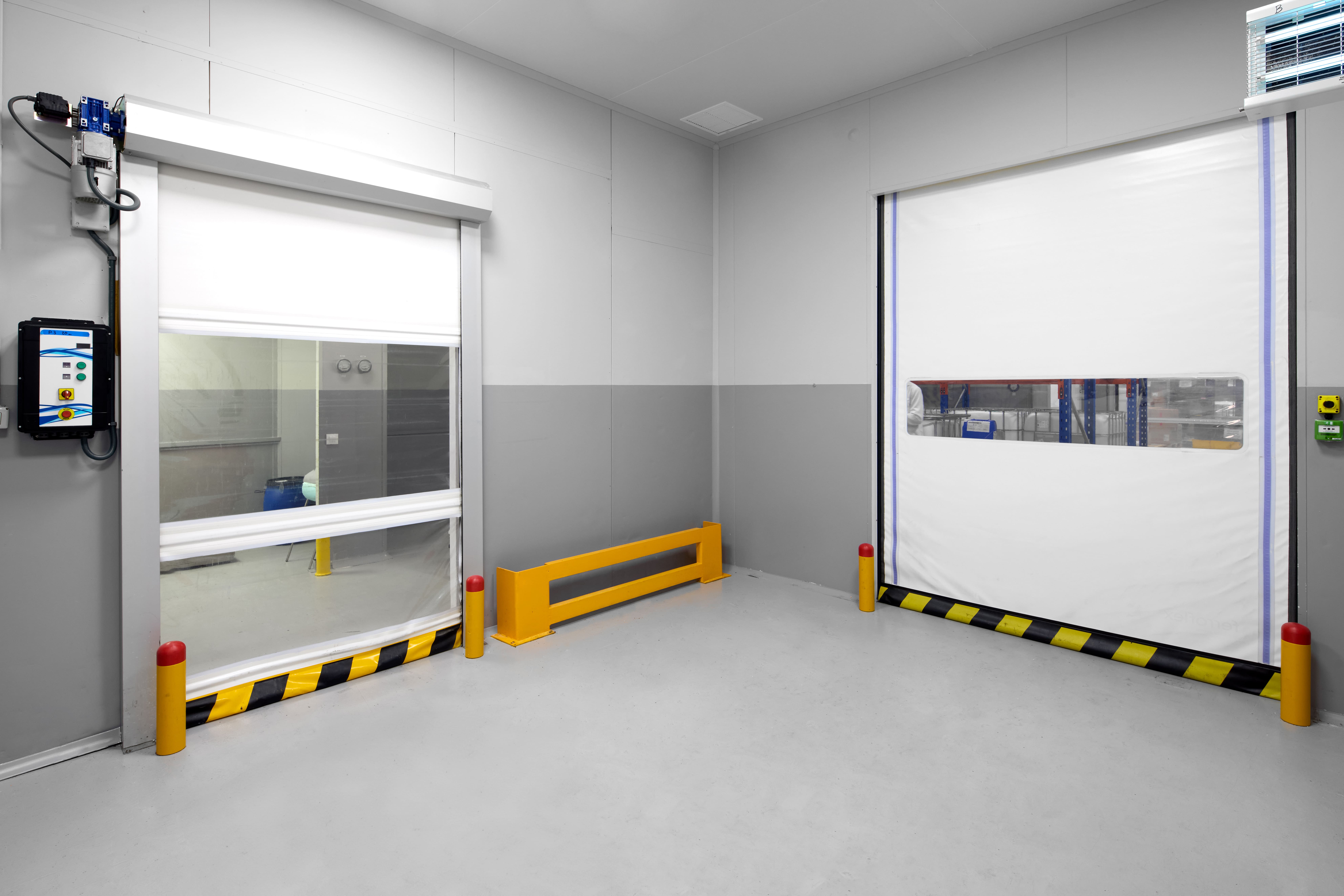
UNE-EN 13241:2004+A2:2017 is the current product standard for industrial, commercial and garage doors, as well as gates included in its scope. It defines the performance characteristics that must be declared for CE marking and sets out requirements relating to stability, strength and safety in use.
It applies to both manually operated and motorised doors, but not to every door fitted with a motor. Automatic horizontal-movement pedestrian doors are regulated by UNE-EN 16361, while fire resistance and smoke control performance are assessed in accordance with UNE-EN 16034.
In this article, we explain what EN 13241 covers, what documentation is required for CE marking, what performance characteristics it addresses, and when a modification necessitates a reassessment of the door.
What does the EN 13241 standard regulate?
EN 13241 is a harmonised product standard. It sets out how a door's performance must be assessed and declared before it is placed on the market.
Conformity is assessed based on the door as a whole, considering its intended use, configuration, components, operating system and the risks associated with its movement. It does not depend solely on the inclusion of specific sensors or safety devices.
When a door is motorised, it is considered both a construction product and a machine. Therefore, in addition to the requirements set out in the Construction Products Regulation, it must comply with the legislation applicable to machinery and electromagnetic compatibility.
The comprehensive guide to industrial doors provides further information on this subject and outlines the main types, applications and selection criteria.
What is the current version of EN 13241?
The current UNE version is UNE-EN 13241:2004+A2:2017, entitled "Industrial, commercial and garage doors and gates. Product standard, performance characteristics".
This edition replaced UNE-EN 13241-1:2004+A1:2011. The A2 version revised the scope of application and excluded automatic horizontal-movement pedestrian doors, which are currently covered by UNE-EN 16361:2014+A1:2017.
Update to the Construction Products Regulation
From 8 January 2026, Regulation (EU) 2024/3110 will apply across the board, gradually replacing Regulation (EU) No 305/2011 on construction products.
The transition, however, is taking place on a product-family basis. While EN 13241 remains linked to the previous regime, the documentation system under Regulation (EU) No 305/2011 continues to apply, including the Declaration of Performance.
To which doors does EN 13241 apply?
The standard applies to industrial, commercial and garage doors, and to gates intended primarily to allow the safe passage of goods and vehicles accompanied or driven by people.
This range includes:
- High-speed roll-up doors.
- High-speed stacking doors.
- Sectional doors.
- Industrial sliding doors.
- Commercial roll-up doors and grilles.
- Manual or motorised gates.
- Garage doors.
It may also include certain roll-up shutters and grilles used as doors for commercial premises, even if they are primarily intended for pedestrian access.
This list is provided for guidance only. The type of door alone is not sufficient to determine the applicable standard. A door falls within the scope of EN 13241 based on its intended use and the function for which it is marketed, not merely because it is a roll-up, sliding or motorised door.
What is excluded from EN 13241?
Distinguishing between the different areas prevents requirements from one standard being applied to a door that falls under another standard.
| Product or service | Main standard |
|---|---|
| Industrial, commercial, garage and gates | UNE-EN 13241 |
| Automatic horizontal pedestrian doors | UNE-EN 16361 |
| Fire resistance and smoke control | UNE-EN 16034 |
| Safety in the use of motorised doors | UNE-EN 12453 |
Automatic pedestrian doors
Motorised doors that move horizontally and are intended primarily for pedestrian use are excluded from EN 13241. Automatic sliding pedestrian doors, curved doors and other horizontal configurations for pedestrian use are governed by UNE-EN 16361.
An automatic pedestrian door and a high-speed industrial door may incorporate a motor and sensors, but they are not assessed against the same product standard. Revolving doors are also expressly excluded from EN 13241.
Fire-resistant or smoke-control doors
EN 13241 does not, on its own, cover fire resistance or smoke control performance. Where an industrial door claims to have either of these characteristics, UNE-EN 16034:2015 must also apply.
EN 13241 regulates the general performance of the product, while EN 16034 regulates performance specifically related to fire and smoke.
You can view our range of fire-resistant industrial doors to discover solutions designed for fire compartmentalisation.
What does the CE marking require of an industrial door?
The CE marking is neither a type approval nor a generic quality certification. It indicates that the manufacturer has carried out the corresponding assessment procedure and has declared that the product's performance complies with the applicable legislation and harmonised standard.
The documentation required varies depending on whether the door is manually operated or motorised:
| Door type | Main documentation |
|---|---|
| Manual door | Declaration of Performance and instructions |
| Motorised door | Declaration of Performance, EC Declaration of Conformity, instructions and maintenance manual |
Declaration of Performance
Manual and motorised doors must be accompanied by a Declaration of Performance, also known as a DoP.
This document:
- Identifies the manufacturer and the product.
- Specifies the intended use.
- Sets out the declared performance.
- Indicates the harmonised standard used.
- Identifies, where applicable, the notified body involved.
The Declaration of Performance must include, as a minimum, the performance of one essential characteristic relating to the intended use. For other characteristics, the abbreviation NPD (meaning 'no performance determined') may be used where the applicable regulation does not require a specific value to be declared.
NPD does not mean that any door is suitable for any application. The declared performance must correspond to the location and actual conditions of the project.
CE marking and identification plate
The CE marking must be affixed in a visible, legible and indelible manner. It usually appears on a rating plate or on a label attached to the door.
This identification allows the following details, among others, to be verified:
- The manufacturer and the product.
- The serial number.
- The year of manufacture or the year the marking was affixed.
- The reference number of the Declaration of Performance.
- The harmonised standard applied.
- The intended use.
- The declared performance characteristics.
EC Declaration of Conformity
Manual doors do not require a declaration of conformity as machinery. Motorised doors must include, in addition to the Declaration of Performance, an EC Declaration of Conformity in accordance with the legislation on machinery and electromagnetic compatibility.
Directive 2006/42/EC will continue to apply until 19 January 2027. From 20 January 2027, with the general application of Regulation (EU) 2023/1230, the term 'EU Declaration of Conformity' will come into use.
Currently:
- The Declaration of Performance applies to the door as a construction product.
- The EC Declaration of Conformity applies to the motorised door as a machine.
Instructions and maintenance
The manufacturer must provide the necessary instructions for the operation, use, safety and maintenance of the door and, where applicable, installation instructions.
A maintenance log must also be provided for motorised doors, in which inspections, repairs and modifications carried out are recorded.
There is no universal annual maintenance schedule applicable to all industrial doors. The frequency should be determined in accordance with the manufacturer's instructions, the door's usage and its operating conditions.
You can find further information on this topic in the section on industrial door maintenance.
Retention of documentation
The manufacturer must retain the technical documentation and the Declaration of Performance for ten years from the date the product was placed on the market.
It is recommended that the owner retains the following for the duration of the door's service life:
- The documentation received.
- The instructions.
- The relevant declarations.
- The maintenance log.
- The record of work carried out.
This history enables the original configuration of the door to be ascertained and any subsequent modifications to be properly assessed.

What performance requirements does EN 13241 cover?
The standard sets out various essential characteristics. Their relevance depends on the intended use; the location, and the requirements defined for the project.
These include:
- Water tightness.
- Wind load resistance.
- Thermal resistance.
- Air permeability.
- Safe opening of vertically moving doors.
- Mechanical strength and stability.
- Operating force for motorised doors.
- Safe geometry of glass components.
- Durability of certain performance characteristics.
Wind resistance and performance of the enclosure
Wind load resistance indicates the door's ability to withstand the positive and negative pressures acting upon it without losing stability or compromising its operation. This performance characteristic is particularly important for doors installed on façades or exposed to the outside.
Thermal resistance, air permeability and watertightness may be required depending on the building's location and conditions. There is no single value applicable to all doors: the required standard must be defined for each individual project.
The CE marking, on its own, does not guarantee that a door is suitable for any location. It must be verified that the declared performance characteristics are appropriate for the installation site.
Safety during operation
In vertically operating doors, safe opening is designed to prevent uncontrolled movement of the door leaf. Mechanical strength and stability ensure that the assembly can withstand the stresses anticipated during operation.
For motorised doors, UNE-EN 12453 complements EN 13241 in areas such as protection against crushing, shearing and entrapment, force limitation and the detection of people or obstacles.
Depending on the design and risk assessment, the following may be incorporated:
- Sensors or photocells.
- Safety edges.
- Force-limiting systems.
- Reversal movement devices.
- Fall arrest or safety catch systems.
- Control panels that monitor the safety devices.
Compliance does not depend on installing all these elements without any criteria. It must be demonstrated that the door as a whole operates safely for its intended use.
Does it include sound insulation?
The table of essential characteristics in EN 13241 does not include any specific acoustic performance requirements. It is therefore not correct to state that this standard assesses the sound transmission of industrial doors.
Where a project requires a specific level of sound insulation, this must be justified by the relevant technical specifications or test results, independently of the harmonised characteristics set out in EN 13241.
When does a modified door need to be reassessed?
Not all repairs or alterations require the assessment to be repeated or a new CE marking to be affixed. A distinction must be made between a minor intervention and a substantial modification.
Minor repair or modification
A minor repair or modification preserves the door's original purpose, type and performance, without introducing new hazards or increasing existing risks.
This may involve, for example, replacing a damaged component with an identical or technically equivalent one. It does not require a new Declaration of Performance or a new CE marking.
The work must be documented and recorded in the maintenance log if the door is motorised.
Substantial modification
A modification may be considered substantial if it alters the performance, purpose or original configuration of the door, creates a new hazard or increases an existing risk.
Changes that may require a reassessment include:
- Motorising a manual door.
- Changing the mass of the door.
- Changing its type or configuration.
- Replacing the motor with one that affects safety functions.
- Changing the activation system or safety control.
- Removing components or protective devices.
In the case of a motorised door, whoever carries out a substantial modification assumes the responsibilities of the manufacturer of the modified machine. It may be necessary to reassess conformity, update the technical documentation, issue a new EC Declaration of Conformity, amend the marking and provide new instructions.
This does not automatically require a new Declaration of Performance. It should only be revised when the modification also affects the characteristics covered by the Construction Products Regulation.
Including new safety devices
Adding photocells, safety brakes or anti-crush systems does not always require new marking. This may be considered a minor modification where it improves safety without substantially altering the purpose, configuration, control system or performance of the door.
The company carrying out the work must assess its scope, document the changes and justify the classification adopted.
What documentation should the property receive?
When installing a new door, the proprietor must check that the CE marking is visible and that the relevant documentation is provided.
For a manual door:
- Declaration of Performance.
- Instructions for operation, use, safety and maintenance.
For a motorised door:
- Declaration of Performance.
- CE Declaration of Conformity.
- Instructions for operation, use, safety and maintenance.
- Maintenance log.
It must also be checked that the declared performance is suitable for the location and intended use.
Conformity must be maintained throughout the product's service life
Compliance with EN 13241 does not end with the affixing of the CE marking. Maintenance, the retention of documentation and the assessment of subsequent modifications ensure that the conditions specified by the manufacturer are maintained.
Replacing the motor, altering the mass, removing safety devices or modifying the control system may affect conformity if the work is not properly assessed and documented.
Before selecting a door, it is necessary to define its intended use, location and the performance it must deliver. To explore these criteria in more detail, you can find out how to choose the best high-speed door for your industry. Based on these criteria, you can browse Manusa's range of industrial doors to discover the available configurations and select the right option for each application.
If this summer you want to improve the comfort of your premises or office, save energy and offer a better experience to your customers, find out how we can help you with the most suitable solution.
Contact us