Andorra
 Austria
 Belgium
 Bosnia and Herzegovina
 Bulgaria
 Cyprus
 Czech Republic
 Denmark
 Deutschland
 France
 Greece
 Hungary
 Ireland
 Iceland
 Israel
 Italy
Italy
 Latvia
 Luxembourg
 Malta
Malta
 Montenegro
 Netherlands
 Norway
 Poland
 Portugal
 Romania
 Serbia
 Slovakia
 Slovenia
 Spain
Spain
 Sweden
 Switzerland
 Turkey
 Ukraine
 United Kingdom
 Argentina
 Bolivia
 Brasil
 Canada
 Chile
Chile
 Colombia
 Costa Rica
 Cuba
Cuba
 República Dominicana
 Ecuador
 El Salvador
 French Guiana
 Guatemala
 Honduras
 México
 Nicaragua
 Panamá
 Paraguay
 Perú
Perú
 Uruguay
 United States
 Venezuela
 Azerbaijan
 China
China
 Hong Kong
 India
India
 Indonesia
 Iraq
Iraq
 Japan
Japan
 Jordan
 Kuwait
 Lebanon
 Malaysia
 Maurice
 Myanmar
 Oman
Oman
 Pakistan
 Philippines
 Qatar
Qatar
 Russia
 Saudi Arabia
 Singapore
 South Korea
 Syria
Syria
 Thailand
 United Arab Emirates
 Vietnam
 Algeria
 Angola
 Egypt
Egypt
 Ghana
Ghana
 Kenya
Kenya
 Libya
Libya
 Morocco
 Nigeria
 Sénégal
 South Africa
 Tanzania
 Tunisie
 Australia
 New Zealand

Choosing between an automatic sliding door and an automatic revolving door does not depend solely on the design of the entrance. The flow of people, the available space, the air conditioning needs and the intended use of the building are some of the factors that should be analysed before making a decision.
This comparison of sliding vs revolving door allows us to understand which solution can respond best in each case. Both are part of the main types of automatic doors, but their operation and performance are different.
The sliding door offers a direct passage and has a great ability to adapt to very diverse spaces and uses. The revolving door, on the other hand, is especially interesting when you are looking to limit air exchange between indoors and outdoors and maintain more stable environmental conditions.
There is no better door in absolute terms. There is the door that responds best to the actual operation of each building.
Traffic, space available, air conditioning and type of user should be analysed together before deciding between a sliding and a revolving door.
Sliding vs revolving: main differences
Sliding and revolving doors automate the passage of people, but they do it differently. This table summarises the main criteria that should be assessed:
In general terms, the sliding door is especially suitable when a direct and versatile passageway is needed. The revolving door takes advantage when there is frequent traffic and it is important to reduce the direct communication between indoor and outdoor conditions.
Two systems, two different ways of occupying space
In a sliding door, the leaves need lateral surface to move during opening. A revolving door, on the other hand, needs sufficient depth to accommodate the entire diameter of the assembly.
Therefore, comparing only the width of the opening gap does not determine which solution fits best.
When to choose an automatic sliding door?
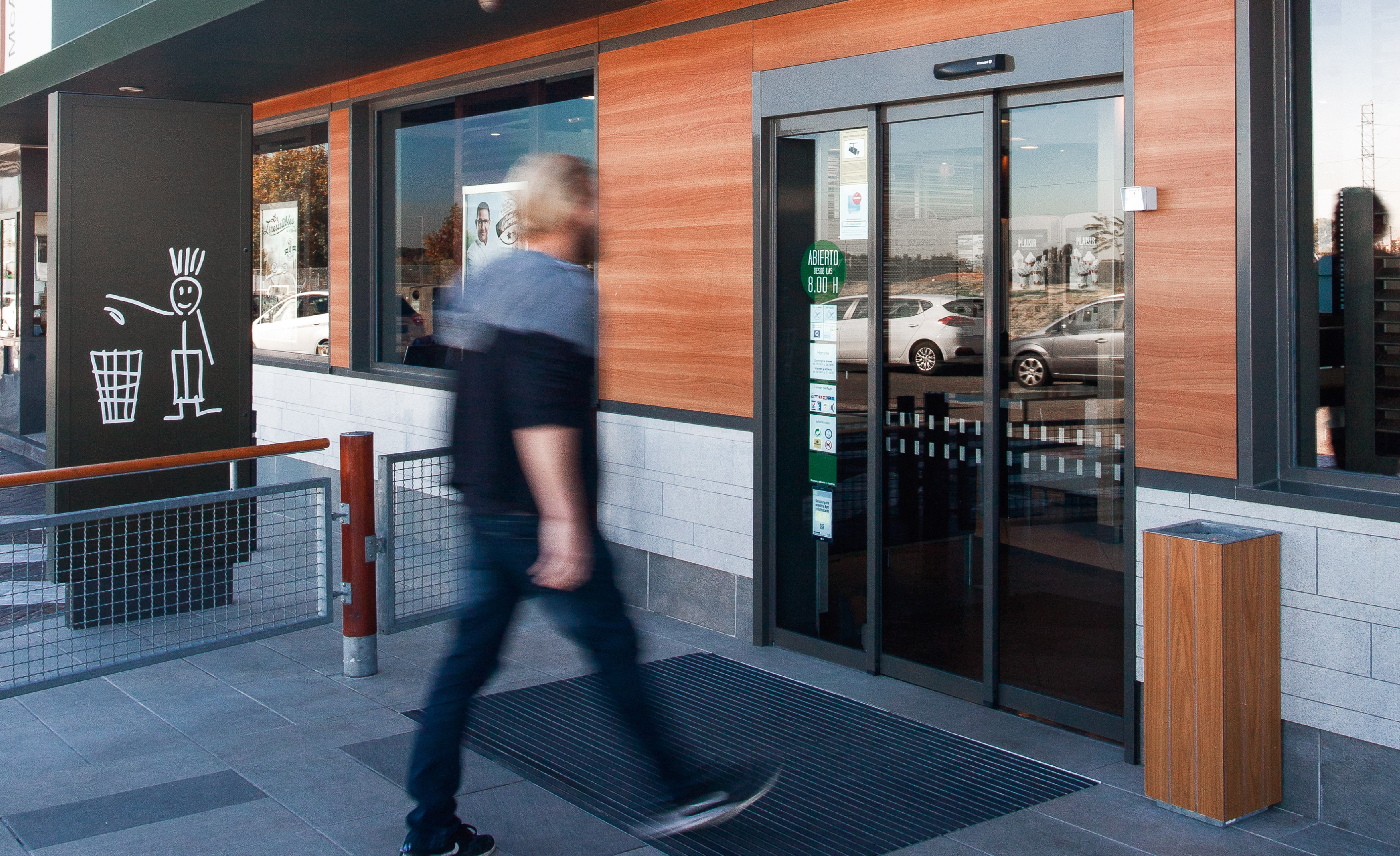
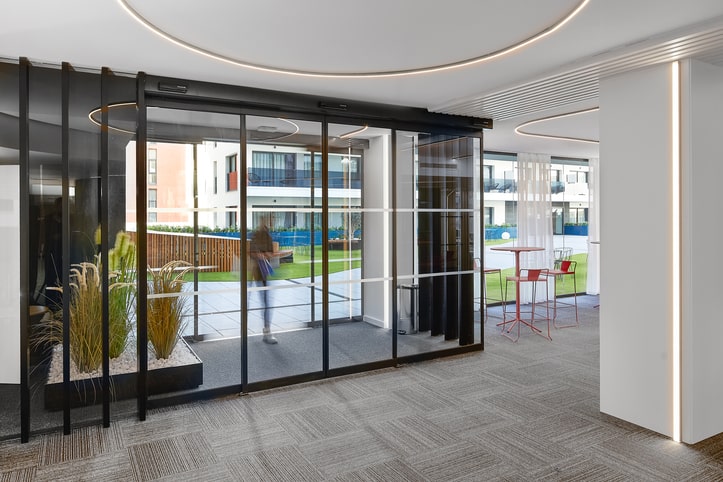
An automatic sliding door is an especially versatile solution when a direct, comfortable and non-contact passageway is needed.
Its leaves move laterally and do not generate a sweeping area in front of or behind the door. This facilitates the organisation of lobbies, corridors and circulation areas where it is important to keep people’s route clear.
It also facilitates the passage of carts, luggage, strollers, stretchers or other bulky items. It matters not only how many people pass through the door, but also how they do it and what they need to transport with them.
Sliding doors can also be adapted to very different architectural configurations. When the available lateral space is reduced, for example, a telescopic sliding door allows several leaves to be overlapped and take better advantage of the opening gap to obtain a wider free passage.
For this reason, the sliding door is usually a good choice when traffic flow, accessibility and ability to adapt to the available space are required.
When the lateral space is limited
With a telescopic door, it is possible to overlap several leaves while opening and make better use of the available opening gap. It can be an alternative when a standard sliding door does not have the necessary free passageway space.

When to choose an automatic revolving door?
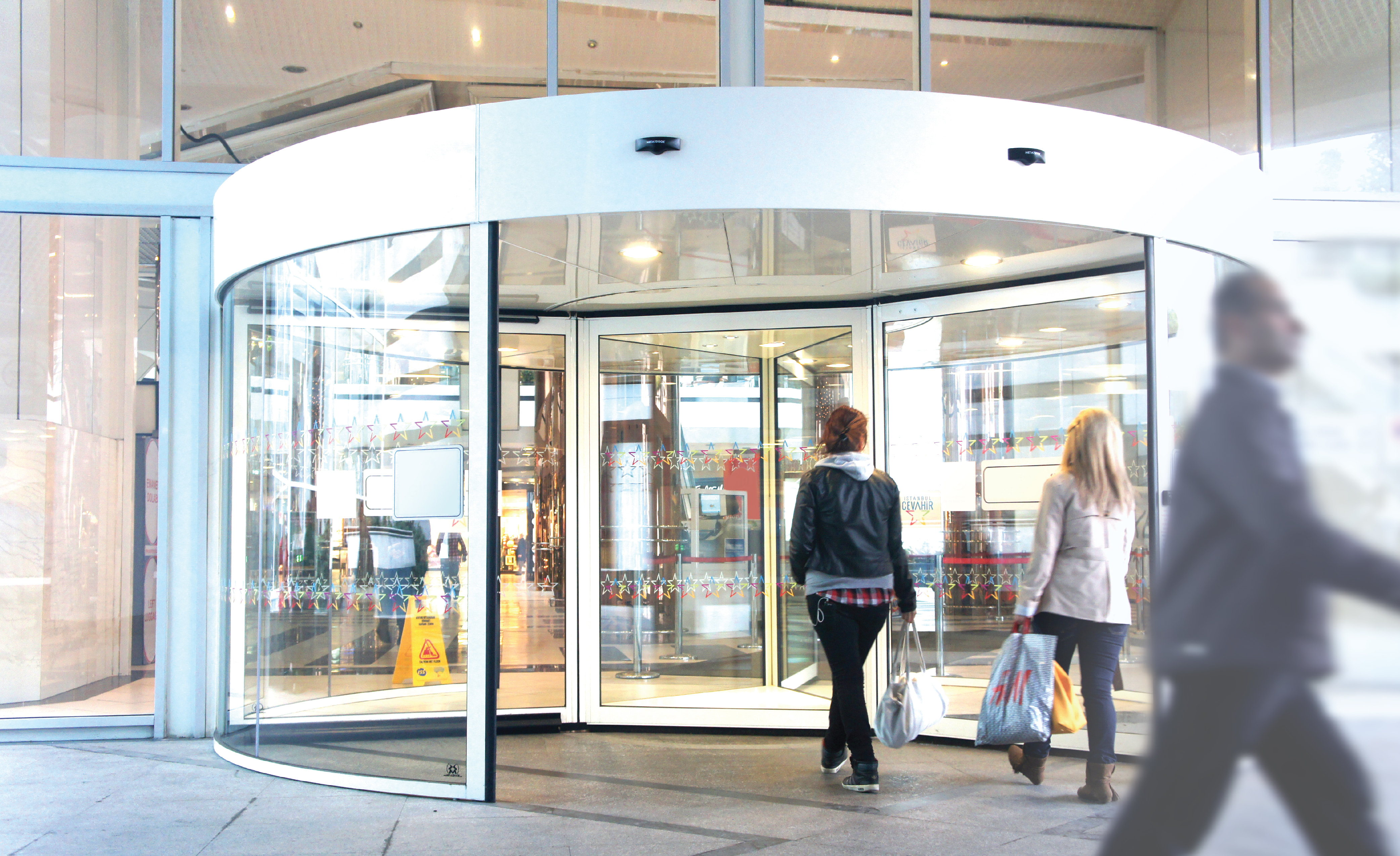
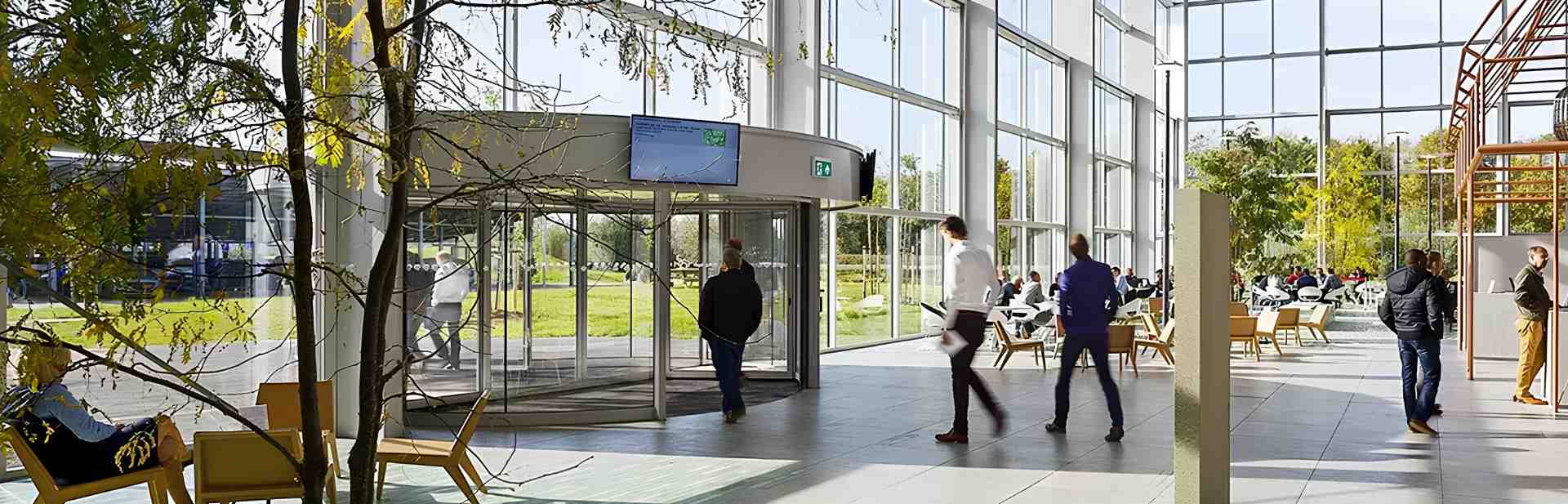
An automatic revolving door works differently. Its leaves rotate around an axis and create different segments through which people enter and exit the building.
This configuration prevents a permanent direct opening between inside and outside spaces while the door is in operation. Thus, it can reduce air draughts and temperature fluctuations, acting as a barrier against noise and certain outdoor environmental conditions.
Revolving doors are specially designed to promote thermal insulation and help maintain more stable interior conditions even when there is continuous use.
For this reason, automatic revolving doors are especially interesting at main entrances with frequent traffic flow and buildings where thermal comfort and energy efficiency are very important, such as hotels, airports, large shopping centres or corporate headquarters.
In addition, there are standard, transparent, multifunction and large-sized configurations that allow the solution to be adapted to the traffic volume and the architectural characteristics of each project.
An entrance that maintains a greater separation from the outside
The geometry of a revolving door prevents the interior and exterior from being directly connected during passage.
This helps to reduce air draughts and temperature fluctuations, a feature that is especially relevant in buildings with heavy foot traffic and air-conditioned entrances.
How does pedestrian flow influence the selection?
The number of users is important, but the traffic volume should not be analysed by itself. It is also useful to know the frequency of passage, the times of greatest influx and how people use the entrance.
A sliding door leaves a passage completely open during each cycle. This facilitates direct movements and is especially practical when people are circulating with cars, luggage or bulky items.
The revolving door organises the traffic in different segments and allows for continuous movement. Its capacity will depend on the diameter, the number of leaves and the chosen configuration.
There are large revolving doors designed for high pedestrian traffic and with enough space to facilitate the passage of wheelchairs, trolleys, large luggage or stretchers.
Therefore, a high flow does not automatically determine whether a sliding door or a revolving door should be installed. The decision also depends on the type of user and the daily operation of the building.
More diameter, more passage capacity
Large revolving doors allow larger segments and adapt the door to high flows and users who circulate with trolleys, luggage or other bulky items.
The final capacity will depend on the diameter and the configuration chosen for the project.
Which door needs more space?
The needs are different in each system.
In a sliding door, there must be enough lateral surface to retract the leaves during opening. If the lateral spaces are reduced, a telescopic configuration can help to make better use of the available space.
A revolving door, on the other hand, needs sufficient depth to accommodate the entire diameter of the assembly. The larger the diameter, the greater the space available within each segment.
Therefore, it is not enough to analyse only the width of the opening gap. It is also necessary to study the surrounding space of the entrance, the routes of the users and the necessary free passage space.
Whenever possible, these needs should be assessed from the early stages of the project so that the door is properly integrated into the architecture and the intended operation of the building.
Which one maintains the air conditioning better?
This is one of the most important differences between the two systems.
A sliding door remains closed while not in use and opens when it detects the approach of a person. However, during this period of opening, there is a direct communication between the interior and the exterior.
The revolving door maintains a physical separation between both environments during passage due to different segments. In this way, it can reduce draughts, facilitate thermal insulation and help keep indoor air conditioning conditions more stable.
This feature becomes especially relevant in exterior entrances with a high frequency of passage or exposed to wind, cold or heat.
Therefore, when thermal comfort and energy efficiency are an important requirement within the project, the revolving door can offer advantages over a sliding one.
Air conditioning and opening frequency
The more frequent the traffic, the more important the air exchange between the outside and the inside.
A revolving door limits this direct communication during passage and can enable more stable interior conditions in buildings with a continuously used entrance.
Sliding or revolving doors depending on the type of building?
The type of building helps to guide the choice, although there may be very different needs within the same sector.
Shops and shopping centres
In shops and supermarkets, a sliding door facilitates a direct passage for customers, bags and carts.
In large shopping centres with exterior entrances and continuous traffic, a revolving door can be especially interesting when looking to reduce air exchange with the outside and maintain more stable indoor conditions.
Hotels
In hotels, both solutions are common.
A sliding door facilitates a comfortable passage with suitcases and luggage. A revolving door can help to protect the air conditioning of the lobby and, at the same time, bring a greater architectural presence to the main entrance.
Airports and public buildings
In airports and large public buildings, the volume and frequency of passage force to carefully study the necessary capacity.
Both sliding doors and certain large-capacity revolving doors can respond to high traffic flows. The choice will depend on the type of traffic, the available space and the environmental conditions of the entrance.
Hospitals
In hospitals, the solution must respond to the specific needs of each area.
A sliding door allows a wide and direct passage for people, equipment or stretchers. There are also high-capacity revolving models suitable for certain main entrances where it is required to combine high pedestrian traffic with a greater separation between indoor and outdoor conditions.
When the project raises other needs or door typologies, it may be useful to consult how to choose an automatic door according to the project.
Sliding or revolving door: which one to choose?
The decision can be summarised in four main criteria:
● Flow and type of users: how many people will use the door, how often and how they will move.
● Available space: lateral surface, depth, dimensions of the opening gap and necessary free passage.
● Environmental conditions: outdoor exposure, air darughts and air conditioning needs.
● Function of the entrance: type of building, intensity of use and architectural requirements of the project.
If a direct, versatile and comfortable passageway is needed for people and bulky items, a sliding door can be better.
If the priority is to maintain a more constant separation between interior and exterior in a frequently used entrance, a revolving door can provide greater advantages.
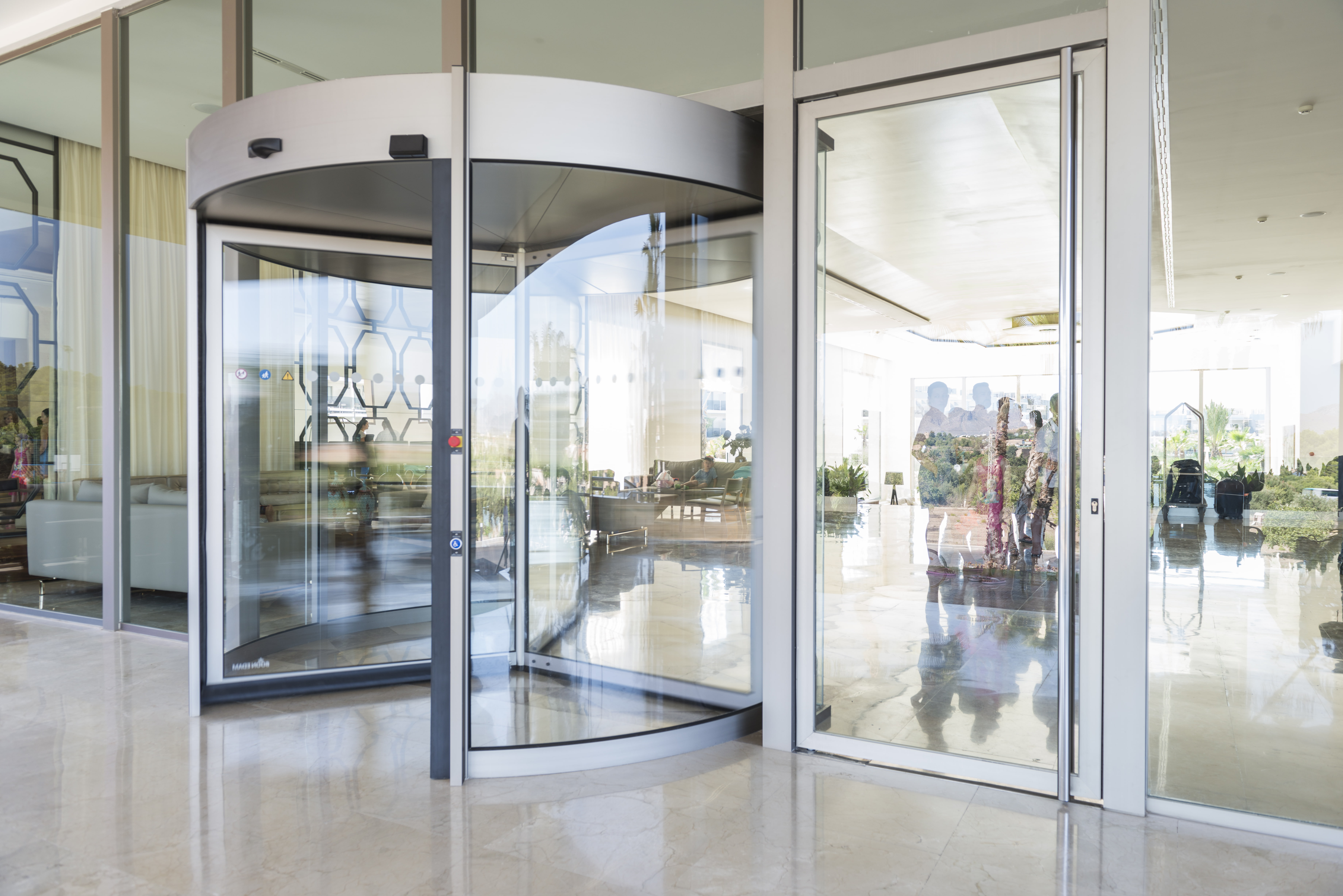
There are projects in which both needs coincide. Certain solutions, such as the multifunction automatic revolving door, integrate an automatic sliding door in the centre, which, if needed, can also have an anti-panic option, or a manual swing door if needed.
What if the project needs both functions?
Certain solutions, such as the multifunction automatic revolving door, integrate a sliding door into the assembly itself.
In this way, the system can adapt its operation to different situations and combine the separation of a revolving door with a direct passageway when the project requires it.
A choice that must start from the operation of the building
Sliding and revolving doors solve different needs. The first one stands out for offering a direct passage and a great ability to adapt. The second one allows maintaining a more constant separation between the interior and the exterior.
Before deciding, it is advisable to analyse the building as a whole: how people circulate, how much space there is, what environmental conditions affect the entrance and what function the door should fulfil in the daily use of space.
Choosing the right one is not just about deciding between a sliding or a revolving door. It consists of defining which solution best responds to the real functional and architectural needs of the project.
A sliding or a revolving door for your project?
The pedestrian flow, the available space, the air conditioning and the intended use of the entrance determine which solution responds best.
Catalogue of revolving doors Manusa
 d90029-en_catalogo puertas automaticas giratorias.pdf

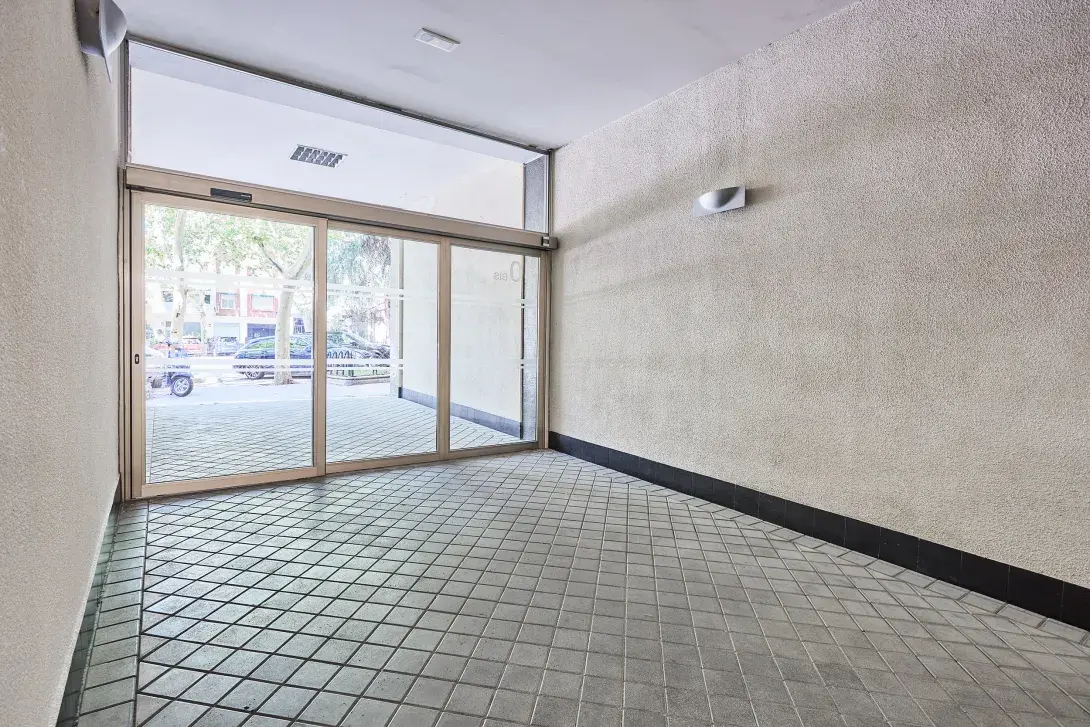
If this summer you want to improve the comfort of your premises or office, save energy and offer a better experience to your customers, find out how we can help you with the most suitable solution.
Contact us
Related solutions
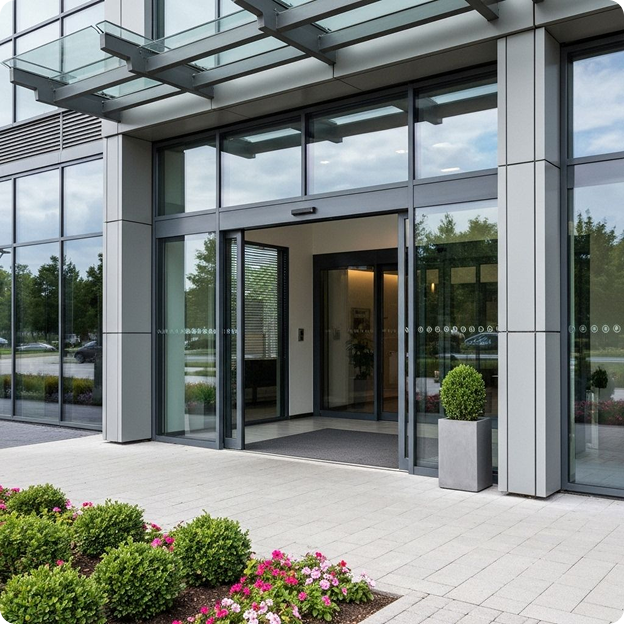
Standard automatic sliding door
Standard automatic revolving door