 Andorra
 Austria
 Belgium
 Bosnia and Herzegovina
 Bulgaria
 Cyprus
 Czech Republic
 Denmark
 Deutschland
 France
 Greece
 Hungary
 Ireland
 Iceland
 Israel
 Italy
Italy
 Latvia
 Luxembourg
 Malta
Malta
 Montenegro
 Netherlands
 Norway
 Poland
 Portugal
 Romania
 Serbia
 Slovakia
 Slovenia
 Spain
Spain
 Sweden
 Switzerland
 Turkey
 Ukraine
 United Kingdom
 Argentina
 Bolivia
 Brasil
 Canada
 Chile
Chile
 Colombia
 Costa Rica
 Cuba
Cuba
 República Dominicana
 Ecuador
 El Salvador
 French Guiana
 Guatemala
 Honduras
 México
 Nicaragua
 Panamá
 Paraguay
 Perú
Perú
 Uruguay
 United States
 Venezuela
 Azerbaijan
 China
China
 Hong Kong
 India
India
 Indonesia
 Iraq
Iraq
 Japan
Japan
 Jordan
 Kuwait
 Lebanon
 Malaysia
 Maurice
 Myanmar
 Oman
Oman
 Pakistan
 Philippines
 Qatar
Qatar
 Russia
 Saudi Arabia
 Singapore
 South Korea
 Syria
Syria
 Thailand
 United Arab Emirates
 Vietnam
 Algeria
 Angola
 Egypt
Egypt
 Ghana
Ghana
 Kenya
Kenya
 Libya
Libya
 Morocco
 Nigeria
 Sénégal
 South Africa
 Tanzania
 Tunisie
 Australia
 New Zealand

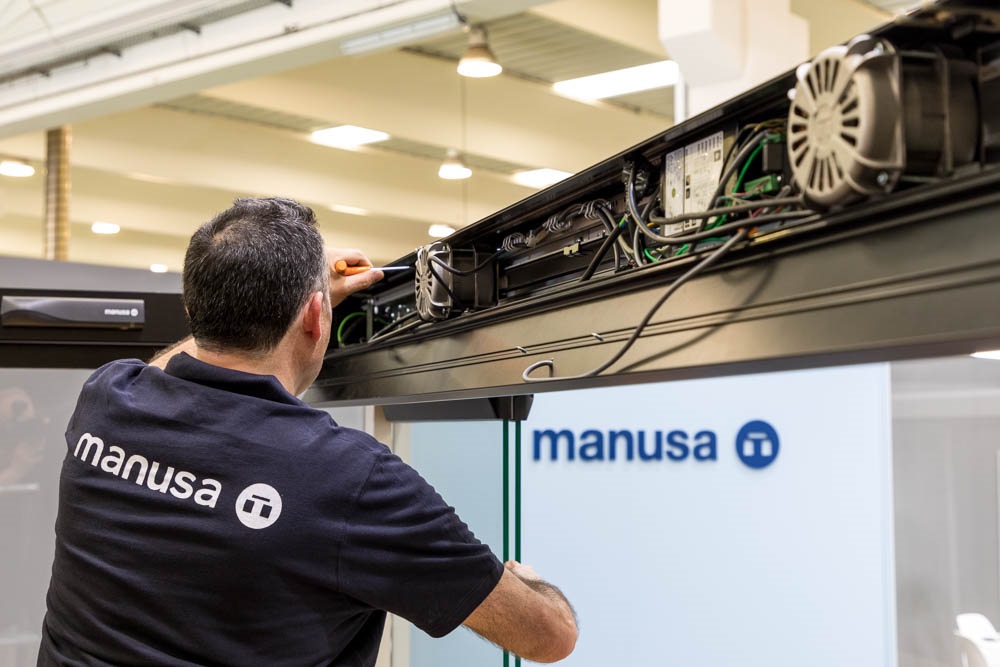
Automatic sliding doors are one of the most standardised access solutions on the market thanks to their versatility, efficiency and ability to manage large flows of people. They can be found in a wide variety of settings, such as office buildings, airport terminals, shopping centres, banks, supermarkets, etc. However, to ensure they function safely, extend their service life and guarantee optimum thermal insulation, they must be fitted to exacting standards by specialist professionals.
The correct installation of automatic sliding doors requires technical precision to ensure compliance with current regulations at all times.
Steps for installing an automatic sliding door
How are automatic sliding doors installed? To ensure the best possible result, the work should always be carried out by authorised professional technicians. The installation is divided into three main stages.
Site survey and analysis: The first step is to assess the location where the door will be fitted and check that it meets the appropriate structural requirements for installation. The floor must be perfectly smooth and levelled, and the walls must be stable. At this stage, we also determine whether the access point will be internal or external and analyse the expected foot traffic.
Design and project documentation: Once the technical feasibility of the installation has been confirmed, the most suitable solution for the space is developed. At this stage, the door’s dimensions, automation requirements and the specific project requirements are defined.
To facilitate the work of architects, engineering firms and consultancy firms, Manusa provides BIM objects that can be integrated into projects from the design stages onwards. This improves coordination between the various parties involved and ensures that the solution is properly defined before manufacture.
- Custom manufacturing: Once the project has been finalised, the door manufacturing process begins. At this stage, aspects such as materials, finishes, colours, profile types and fittings are determined. The motor operator and the systems required to guarantee the performance and functionality needed for each installation are also recommended.
- Installation and commissioning: Although installation may seem straightforward, an automatic door requires the involvement of authorised technical staff. They are responsible for installing, connecting the operator, synchronising the safety systems and carrying out all the necessary checks to ensure safe and reliable operation.
Types of automatic sliding doors
There are various models of automatic sliding doors that can be adapted to the architectural and operational requirements of a wide range of spaces, such as shops, hotels, offices, healthcare centres, airport terminals, etc.
These are some of the most common types of automatic sliding doors:
- Standard automatic sliding door: Versatile and functional, ideal for areas with heavy foot traffic, it offers high opening speed, maximum safety and a design that allows for greater integration with the architectural surroundings, while also optimising the building’s energy efficiency.
- Telescopic automatic sliding door: This option is perfect for architectural projects where entrances have space constraints or where access to narrow spaces needs to be maximised, while requiring a wider clear opening.
- Curved and semi-circular sliding door: Elegant and distinctive, consisting of an automatic door with one or two moving leaves that slide radially. It can be fitted with glass and a concave or convex frame with different radii and degrees of curvature, creating an attractive entrance whilst offering all the benefits of accessibility, comfort and security.
At Manusa, we also offer automatic sliding doors designed specifically for sectors with more demanding requirements, such as hermetic doors for healthcare environments or fire-resistant doors.
Preventive maintenance of automatic doors
Regular maintenance and servicing are essential to ensure that automatic doors operate correctly, remain up to standard and prevent potential breakdowns.
Maintenance plans monitor doors, checking both their condition and the correct functioning of their components. During these inspections, technicians identify wear and tear or faults before they can develop into more serious problems, thereby preventing operational disruption and associated costs. It is also essential to lubricate moving components and mechanisms and to keep the sensor area clean.
If you need automatic doors for your business or project, contact Manusa to finalise the details and get answers to your questions.
If this summer you want to improve the comfort of your premises or office, save energy and offer a better experience to your customers, find out how we can help you with the most suitable solution.
Contact us